

Ch.5 - Periodicity & Electronic Structure of Atoms
McMurry - Chemistry 8th Edition
McMurry8th EditionChemistryISBN: 9781292336145Non è quello che usi tu?Cambia libro di testo
Capitolo 5, Problema 108

How many unpaired electrons are present in each of the following ground-state atoms? (a) O (b) Si (c) K (d) As

Guida verificata passo dopo passo
1
Determine the electron configuration for each atom in its ground state.
For oxygen (O), with atomic number 8, the electron configuration is 1s^2 2s^2 2p^4.
For silicon (Si), with atomic number 14, the electron configuration is 1s^2 2s^2 2p^6 3s^2 3p^2.
For potassium (K), with atomic number 19, the electron configuration is 1s^2 2s^2 2p^6 3s^2 3p^6 4s^1.
For arsenic (As), with atomic number 33, the electron configuration is 1s^2 2s^2 2p^6 3s^2 3p^6 3d^10 4s^2 4p^3.

Risposta video verificata per un problema simile:

Questa soluzione video è stata consigliata dai nostri tutor come utile per risolvere questo problema.
Durata del video:
3m

Concetti chiave

Ecco i concetti essenziali che devi comprendere per rispondere correttamente alla domanda.

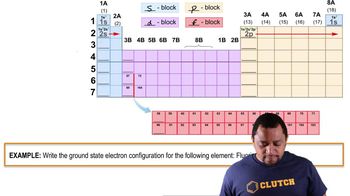
Electron Configuration

Electron configuration describes the distribution of electrons in an atom's orbitals. It follows the Aufbau principle, which states that electrons fill the lowest energy orbitals first. Understanding the electron configuration of an atom is essential for determining the number of unpaired electrons, as it reveals how electrons are arranged in subshells.
Video consigliato:
Percorso guidato
01:33
Electron Configuration Example

Pauli Exclusion Principle

The Pauli Exclusion Principle states that no two electrons in an atom can have the same set of quantum numbers. This principle leads to the concept of paired and unpaired electrons, where paired electrons occupy the same orbital with opposite spins, while unpaired electrons exist in orbitals alone. This principle is crucial for identifying unpaired electrons in an atom's ground state.
Video consigliato:
Percorso guidato
02:05
Uncertainty Principle Formula

Hund's Rule

Hund's Rule states that electrons will occupy degenerate orbitals singly before pairing up. This means that when filling orbitals of the same energy level, each orbital gets one electron first, which helps maximize the number of unpaired electrons. Understanding this rule is vital for accurately determining the number of unpaired electrons in an atom's ground state.
Video consigliato:
Percorso guidato
00:28
Solubility Rules