Ch.5 - Periodicity & Electronic Structure of Atoms
McMurry - Chemistry 8th Edition
McMurry8th EditionChemistryISBN: 9781292336145Non è quello che usi tu?Cambia libro di testo
Capitolo 5, Problema 30

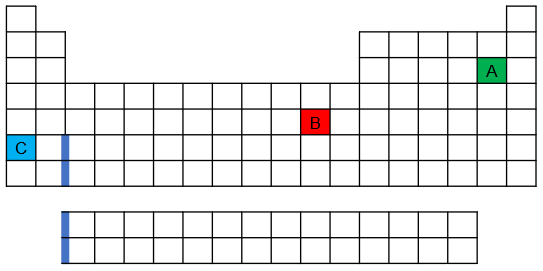
One of the elements shown on the following periodic table has an anomalous ground-state electron configuration. Which is it—red, blue, or green—and why? Periodic table highlighting elements A (green), B (red), and C (blue) for electron configuration discussion.

Guida verificata passo dopo passo
1
Identify the elements corresponding to the highlighted positions on the periodic table: A (green), B (red), and C (blue).
Determine the expected ground-state electron configurations for each of these elements based on their positions in the periodic table.
Compare the expected electron configurations with known anomalous configurations for certain elements.
Recognize that some elements, particularly in the d-block, have electron configurations that deviate from the expected pattern due to stability considerations.
Conclude which element (A, B, or C) has an anomalous ground-state electron configuration and explain why this deviation occurs.

Risposta video verificata per un problema simile:

Questa soluzione video è stata consigliata dai nostri tutor come utile per risolvere questo problema.
Durata del video:
3m

Concetti chiave

Ecco i concetti essenziali che devi comprendere per rispondere correttamente alla domanda.

Electron Configuration

Electron configuration describes the distribution of electrons in an atom's orbitals. It follows the Aufbau principle, which states that electrons fill orbitals starting from the lowest energy level to the highest. Understanding electron configuration is crucial for predicting an element's chemical properties and behavior, including its reactivity and bonding characteristics.
Video consigliato:
Percorso guidato
01:33
Electron Configuration Example

Anomalous Electron Configurations

Anomalous electron configurations occur when an atom's electron arrangement deviates from the expected order based on the Aufbau principle. This typically happens in transition metals and some heavier elements, where stability is achieved by having half-filled or fully filled subshells. Recognizing these anomalies is essential for understanding the unique properties of certain elements.
Video consigliato:
Percorso guidato
01:33
Electron Configuration Example

Periodic Table Trends

The periodic table organizes elements based on their atomic number and electron configurations, revealing trends in properties such as electronegativity, ionization energy, and atomic radius. Elements in the same group often exhibit similar chemical behaviors due to their similar valence electron configurations. Analyzing these trends helps identify which element may have an anomalous configuration based on its position in the table.
Video consigliato:
Percorso guidato
00:38
Periodic Trends