
Ch.5 - Periodicity & Electronic Structure of Atoms
McMurry - Chemistry 8th Edition
McMurry8th EditionChemistryISBN: 9781292336145Non è quello che usi tu?Cambia libro di testo
Capitolo 5, Problema 7

Which arrow in the energy diagram for an atom represents the absorption of light with the shortest wavelength? (LO 5.7) Energy diagram showing transitions in the Bohr model; arrows indicate light absorption.

Guida verificata passo dopo passo
1
Identify the energy levels (n) involved in each transition shown by the arrows in the diagram.
Recall that the energy difference between levels is given by the formula: \( \Delta E = E_f - E_i \), where \( E_f \) is the final energy level and \( E_i \) is the initial energy level.
Understand that the absorption of light corresponds to an electron moving from a lower energy level to a higher energy level.
Recognize that the shortest wavelength corresponds to the highest energy transition, as energy and wavelength are inversely related by the equation: \( E = \frac{hc}{\lambda} \).
Determine which arrow represents the transition with the largest energy difference (\( \Delta E \)), as this will correspond to the absorption of light with the shortest wavelength.

Risposta video verificata per un problema simile:

Questa soluzione video è stata consigliata dai nostri tutor come utile per risolvere questo problema.
Durata del video:
57s

Concetti chiave

Ecco i concetti essenziali che devi comprendere per rispondere correttamente alla domanda.

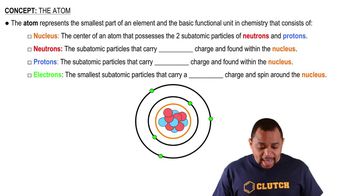
Energy Levels in Atoms

Atoms have quantized energy levels, represented by principal quantum numbers (n). Electrons can occupy these levels, and transitions between them involve the absorption or emission of energy, typically in the form of light. The greater the difference in energy between levels, the higher the energy (and shorter the wavelength) of the absorbed or emitted light.
Video consigliato:

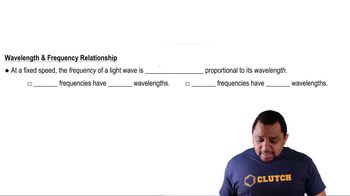
Wavelength and Energy Relationship

The energy of a photon is inversely related to its wavelength, described by the equation E = hc/λ, where E is energy, h is Planck's constant, c is the speed of light, and λ is the wavelength. Therefore, shorter wavelengths correspond to higher energy photons. This relationship is crucial for understanding which transitions in an energy diagram correspond to the absorption of light with the shortest wavelength.
Video consigliato:
Percorso guidato
00:31
Frequency-Wavelength Relationship

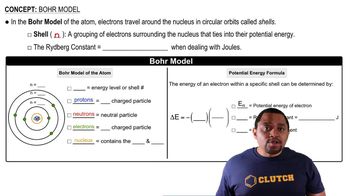
Bohr Model of the Atom

The Bohr model describes the behavior of electrons in hydrogen-like atoms, where electrons orbit the nucleus in defined energy levels. When an electron absorbs energy, it can move to a higher energy level, which is depicted in energy diagrams with arrows indicating the direction of the transition. The arrows' lengths and positions reflect the energy differences between levels, helping to identify which transition corresponds to the absorption of light with the shortest wavelength.
Video consigliato:
Percorso guidato
02:43
Bohr Model of the Atom