Ch.5 - Periodicity & Electronic Structure of Atoms
McMurry - Chemistry 8th Edition
McMurry8th EditionChemistryISBN: 9781292336145Non è quello che usi tu?Cambia libro di testo
Capitolo 5, Problema 1

Which wave corresponds to higher energy radiation? (LO 5.1) (a)
(b)

Guida verificata passo dopo passo
1
Identify the relationship between wavelength and energy. Recall that energy (E) of a wave is inversely proportional to its wavelength (\(\lambda\)), as described by the equation \(E = \frac{hc}{\lambda}\), where \(h\) is Planck's constant and \(c\) is the speed of light.
Determine the wavelengths of the waves in options (a) and (b). If not directly given, use any provided information or context clues to infer or calculate the wavelengths.
Compare the wavelengths of the two waves. The wave with the shorter wavelength will have higher energy, according to the inverse relationship between energy and wavelength.
Conclude which wave, (a) or (b), has the shorter wavelength and therefore corresponds to higher energy radiation.
Apply this understanding to any further analysis or questions related to the properties of electromagnetic radiation and their implications in various contexts.

Risposta video verificata per un problema simile:

Questa soluzione video è stata consigliata dai nostri tutor come utile per risolvere questo problema.
Durata del video:
1m

Concetti chiave

Ecco i concetti essenziali che devi comprendere per rispondere correttamente alla domanda.

Electromagnetic Spectrum

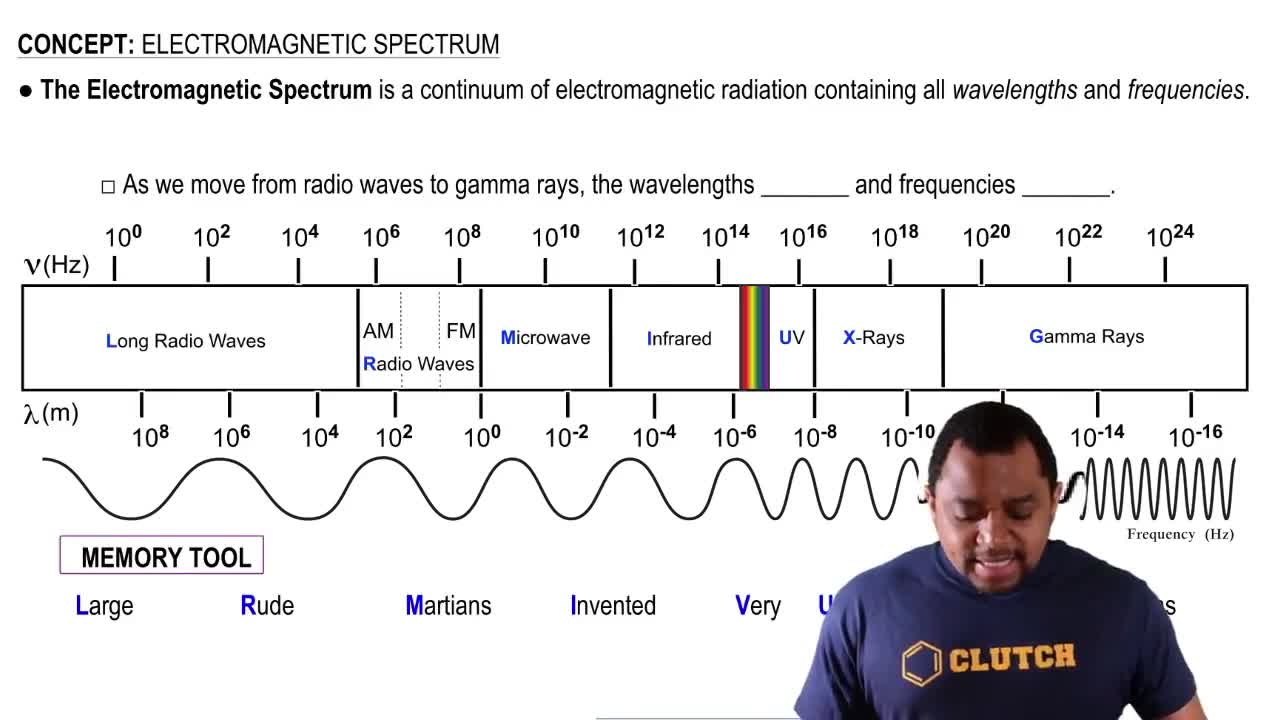
The electromagnetic spectrum encompasses all types of electromagnetic radiation, arranged by wavelength and frequency. It ranges from radio waves with long wavelengths to gamma rays with very short wavelengths. Higher energy radiation corresponds to shorter wavelengths and higher frequencies, which are found at the ultraviolet, X-ray, and gamma-ray regions of the spectrum.
Video consigliato:
Percorso guidato
02:53
Electromagnetic Spectrum

Energy-Frequency Relationship

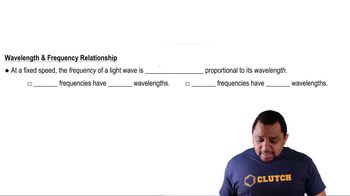
The energy of a photon is directly proportional to its frequency and inversely proportional to its wavelength, as described by the equation E = hν, where E is energy, h is Planck's constant, and ν is frequency. This means that as the frequency of radiation increases, so does its energy, making high-frequency waves like X-rays and gamma rays more energetic than lower-frequency waves like radio waves.
Video consigliato:
Percorso guidato
00:31
Frequency-Wavelength Relationship

Photon Energy

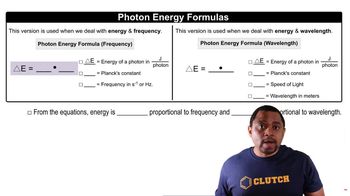
Photons are the fundamental particles of light and other forms of electromagnetic radiation. The energy of a photon is quantized and can be calculated using the formula E = hc/λ, where h is Planck's constant, c is the speed of light, and λ is the wavelength. Thus, shorter wavelengths correspond to higher energy photons, which is crucial for understanding the nature of radiation and its effects.
Video consigliato:
Percorso guidato
01:40
Photon Energy Formulas