Ch.5 - Periodicity & Electronic Structure of Atoms
McMurry - Chemistry 8th Edition
McMurry8th EditionChemistryISBN: 9781292336145Non è quello che usi tu?Cambia libro di testo
Capitolo 5, Problema 75

Why do we have to use an arbitrary value such as 90% to determine the spatial limitations of an orbital?

Guida verificata passo dopo passo
1
Understand that orbitals are mathematical functions describing the probability of finding an electron in a particular region around the nucleus. These functions are solutions to the Schrödinger equation for electrons in atoms.
Recognize that the shape and size of an orbital are determined by the square of the wave function, which gives the electron density distribution around the nucleus.
Acknowledge that the electron density does not have a sharp boundary; instead, it decreases gradually with distance from the nucleus. Therefore, we need a way to define the 'size' of an orbital practically.
Realize that using an arbitrary percentage like 90% to define the boundary of an orbital is a convention that allows chemists to discuss and visualize the most probable region where an electron can be found. This percentage is not fixed and can vary depending on the context or specific needs of a discussion or calculation.
Learn that by choosing a specific percentage, such as 90%, we are essentially saying that there is a 90% probability of finding the electron within this defined space, which simplifies understanding and communication about electron positions in atoms.

Risposta video verificata per un problema simile:

Questa soluzione video è stata consigliata dai nostri tutor come utile per risolvere questo problema.
Durata del video:
1m

Concetti chiave

Ecco i concetti essenziali che devi comprendere per rispondere correttamente alla domanda.

Quantum Mechanics

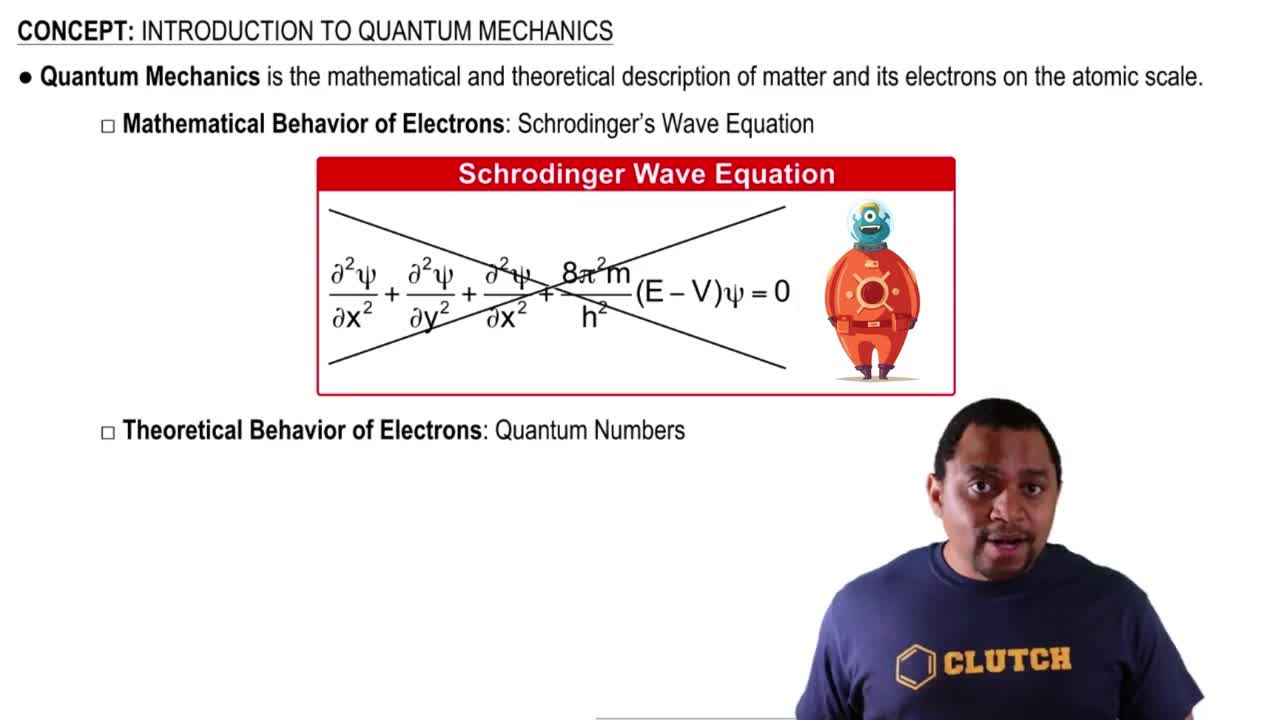
Quantum mechanics is the branch of physics that describes the behavior of matter and energy at atomic and subatomic levels. It introduces the concept of wave-particle duality and the uncertainty principle, which states that certain pairs of physical properties, like position and momentum, cannot be simultaneously known to arbitrary precision. This framework is essential for understanding how electrons occupy orbitals around an atom.
Video consigliato:
Percorso guidato
01:
Introduction to Quantum Mechanics

Atomic Orbitals

Atomic orbitals are mathematical functions that describe the probability distribution of an electron in an atom. Each orbital has a specific shape and energy level, which influences how electrons are arranged around the nucleus. The spatial limitations of an orbital are often represented by a boundary that encompasses a certain percentage of the electron's probability density, commonly set at 90%, to provide a practical way to visualize where an electron is likely to be found.
Video consigliato:
Percorso guidato
01:51
Atomic Orbitals Example

Probability Density

Probability density is a concept in quantum mechanics that quantifies the likelihood of finding a particle, such as an electron, in a particular region of space. It is derived from the square of the wave function associated with the particle. By using a threshold like 90%, chemists can define a region where there is a high probability of locating the electron, thus allowing for a more manageable understanding of electron distribution within orbitals.
Video consigliato:
Percorso guidato
01:56
Density Concepts