Ch.6 - Ionic Compounds: Periodic Trends and Bonding Theory
McMurry - Chemistry 8th Edition
McMurry8th EditionChemistryISBN: 9781292336145Non è quello che usi tu?Cambia libro di testo
Capitolo 6, Problema 38c

How many protons and electrons are in each of the following ions? (c) Se2-

Guida verificata passo dopo passo
1
Step 1: Identify the atomic number of the element. The atomic number of an element is equal to the number of protons in its nucleus. For Selenium (Se), the atomic number is 34, which means it has 34 protons.
Step 2: Determine the number of electrons in the neutral atom. In a neutral atom, the number of protons is equal to the number of electrons. So, a neutral Selenium atom also has 34 electrons.
Step 3: Consider the charge of the ion. The charge of an ion is determined by the difference between the number of protons and electrons. A negative charge indicates that there are more electrons than protons.
Step 4: Calculate the number of electrons in the ion. Since Se2- has a charge of -2, it means it has 2 more electrons than protons. So, add 2 to the number of electrons in the neutral atom.
Step 5: The Se2- ion has 34 protons (from Step 1) and 36 electrons (from Step 4).

Risposta video verificata per un problema simile:

Questa soluzione video è stata consigliata dai nostri tutor come utile per risolvere questo problema.
Durata del video:
1m

Concetti chiave

Ecco i concetti essenziali che devi comprendere per rispondere correttamente alla domanda.

Atomic Structure

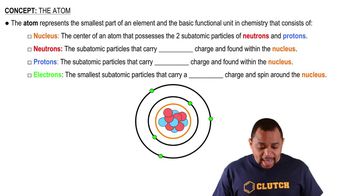
Atoms consist of protons, neutrons, and electrons. Protons are positively charged particles found in the nucleus, while electrons are negatively charged and orbit the nucleus. The number of protons defines the element, and in a neutral atom, the number of electrons equals the number of protons.
Video consigliato:

Ions

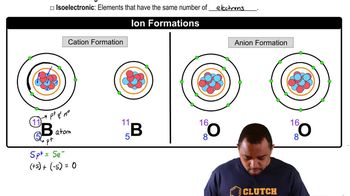
Ions are atoms or molecules that have gained or lost one or more electrons, resulting in a net charge. Cations are positively charged ions formed by losing electrons, while anions are negatively charged ions formed by gaining electrons. The charge of an ion indicates the difference between the number of protons and electrons.
Video consigliato:

Selenium Ion (Se2-)

Selenium (Se) has an atomic number of 34, meaning it has 34 protons in its neutral state. The Se2- ion indicates that the selenium atom has gained two additional electrons, resulting in a total of 36 electrons. Therefore, in the Se2- ion, there are 34 protons and 36 electrons.
Video consigliato: