Ch.6 - Ionic Compounds: Periodic Trends and Bonding Theory
McMurry - Chemistry 8th Edition
McMurry8th EditionChemistryISBN: 9781292336145Non è quello che usi tu?Cambia libro di testo
Capitolo 6, Problema 46

There are two elements in the transition-metal series Sc through Zn that have four unpaired electrons in their 2+ ions. Identify them.

Guida verificata passo dopo passo
1
Step 1: The transition metals from Scandium (Sc) to Zinc (Zn) are in the 3d series of the periodic table. The electron configurations of these elements in their neutral state are typically [Ar] 4s2 3dn, where n varies from 1 to 10 as you move from Sc to Zn.
Step 2: When these elements form 2+ ions, they lose two electrons. The 4s electrons are lost first, so the electron configuration of the 2+ ions is [Ar] 3dn-2.
Step 3: To have four unpaired electrons in the 3d orbitals, n-2 must be equal to 4. Solving this equation gives n = 6.
Step 4: The elements with n = 6 in the 3d series are Chromium (Cr) and Manganese (Mn). However, Chromium has an anomalous electron configuration in its neutral state ([Ar] 4s1 3d5) due to stability of half-filled d-orbital. So, when it loses two electrons to form Cr2+, it loses one from the 4s orbital and one from the 3d orbital, resulting in [Ar] 3d4 configuration with four unpaired electrons.
Step 5: Manganese in its neutral state has the electron configuration [Ar] 4s2 3d5. When it loses two electrons to form Mn2+, it loses both from the 4s orbital, resulting in [Ar] 3d5 configuration. However, this configuration has five unpaired electrons, not four. So, Manganese does not meet the criteria.

Risposta video verificata per un problema simile:

Questa soluzione video è stata consigliata dai nostri tutor come utile per risolvere questo problema.
Durata del video:
4m

Concetti chiave

Ecco i concetti essenziali che devi comprendere per rispondere correttamente alla domanda.

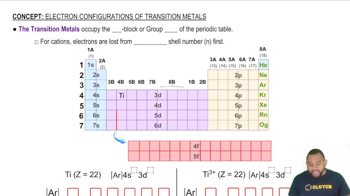
Transition Metals

Transition metals are elements found in the d-block of the periodic table, characterized by their ability to form variable oxidation states and colored compounds. They typically have partially filled d-orbitals, which play a crucial role in their chemical properties and bonding behavior.
Video consigliato:
Percorso guidato
03:12
Transition Metals

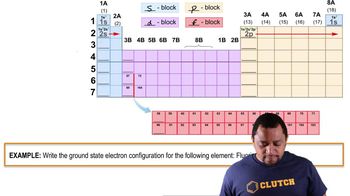
Electron Configuration

Electron configuration describes the distribution of electrons in an atom's orbitals. For transition metals, the electron configuration can change with ionization, affecting the number of unpaired electrons. Understanding how to write and interpret these configurations is essential for identifying the oxidation states and magnetic properties of the elements.
Video consigliato:
Percorso guidato
01:33
Electron Configuration Example

Unpaired Electrons

Unpaired electrons are electrons that occupy an orbital alone rather than in pairs. The number of unpaired electrons in an atom or ion influences its magnetic properties and reactivity. In the context of transition metals, identifying the number of unpaired electrons in their ions helps determine their oxidation states and chemical behavior.
Video consigliato:
Percorso guidato
04:44
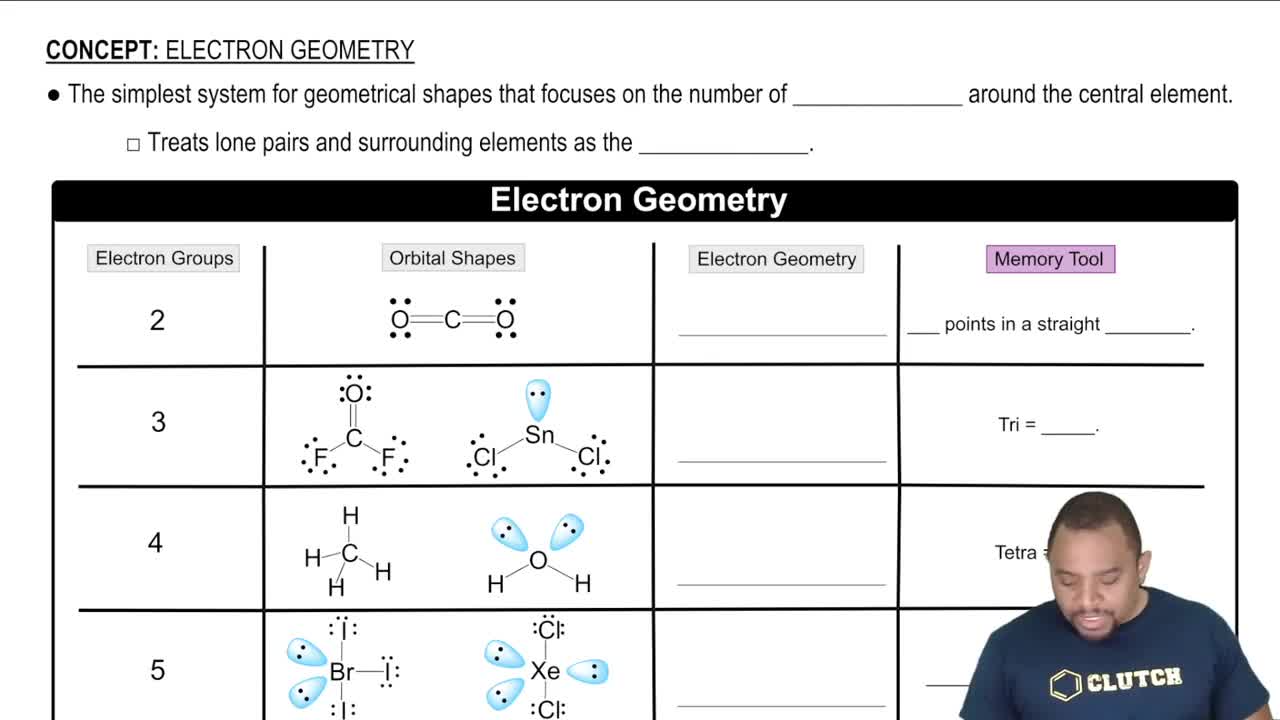
Electron Geometry