
Given the following values for steps in the formation of CaO(s) from its elements, draw a Born–Haber cycle similar to that shown in Figure 6.7. Eea1 for O1g2 = -141 kJ/mol Eea2 for O1g2 = 745.1 kJ/mol Heat of sublimation for Ca1s2 = 178 kJ/mol Ei1 for Ca1g2 = 590 kJ/mol Ei1 for Ca1g2 = 1145 kJ/mol Bond dissociation energy for O21g2 = 498 kJ/mol Lattice energy for CaO1s2 = 3401 kJ/mol
Ch.6 - Ionic Compounds: Periodic Trends and Bonding Theory
Tutti i libri di testo
McMurry 8th Edition
Ch.6 - Ionic Compounds: Periodic Trends and Bonding Theory
Problema 36
McMurry 8th Edition
Ch.6 - Ionic Compounds: Periodic Trends and Bonding Theory
Problema 36Capitolo 6, Problema 36
What is the difference between a molecule and an ion?
Guida verificata passo dopo passo1
1. A molecule is a group of two or more atoms held together by chemical bonds. These atoms can be of the same element, like O2 (oxygen molecule), or of different elements, like H2O (water molecule). Molecules are electrically neutral, meaning they have no net charge.
2. An ion, on the other hand, is an atom or group of atoms that has gained or lost one or more electrons, giving it a net positive or negative charge. If an atom or molecule loses electrons, it becomes a positively charged ion, or cation. If it gains electrons, it becomes a negatively charged ion, or anion. Examples include Na+ (sodium ion) and Cl- (chloride ion).
3. In summary, the main difference between a molecule and an ion lies in their electrical charge. Molecules are neutral, while ions carry a positive or negative charge due to the loss or gain of electrons.

Risposta video verificata per un problema simile:
Questa soluzione video è stata consigliata dai nostri tutor come utile per risolvere questo problema.
Durata del video:
57sConcetti chiave
Ecco i concetti essenziali che devi comprendere per rispondere correttamente alla domanda.
Molecule
A molecule is a group of two or more atoms bonded together by covalent bonds. These atoms can be of the same element, as in O2, or different elements, as in H2O. Molecules are electrically neutral, meaning they have no overall charge, and they represent the smallest fundamental unit of a chemical compound that retains its chemical properties.
Video consigliato:
Percorso guidato
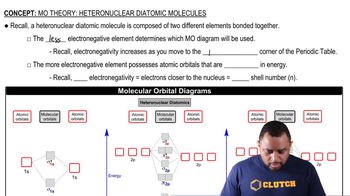
Heteronuclear Diatomic Molecules
Ion
An ion is an atom or molecule that has gained or lost one or more electrons, resulting in a net electrical charge. Ions can be positively charged (cations) or negatively charged (anions). For example, Na+ is a cation formed when sodium loses an electron, while Cl- is an anion formed when chlorine gains an electron. Ions play a crucial role in chemical reactions and electrical conductivity.
Video consigliato:
Percorso guidato
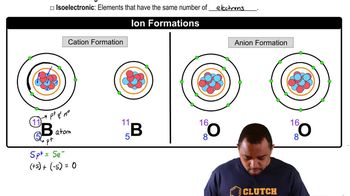
Ion Formation
Chemical Bonding
Chemical bonding refers to the forces that hold atoms together in molecules and ions. In molecules, atoms are typically held together by covalent bonds, where they share electrons. In contrast, ions are held together by ionic bonds, which occur between oppositely charged ions. Understanding these bonding types is essential for distinguishing between molecules and ions and their respective properties.
Video consigliato:
Percorso guidato
Chemical Bonds
Pratica correlata
Domanda del libro di testo
559
views
Domanda del libro di testo
Label the following species as molecules or ions. (c) NO2
338
views
Domanda del libro di testo
Three binary compounds are represented on the following drawing: red with red, blue with blue, and green with green. Give a likely formula for each compound.
499
views
Domanda del libro di testo
How many protons and electrons are in each of the following ions? (a) Be2+
1200
views
Domanda del libro di testo
Label the following species as molecules or ions. (a) NO3– (b) NH4+ (d) CH3CO2–
493
views
Domanda del libro di testo
Which of the following spheres is likely to represent a metal atom and which a nonmetal atom? Which sphere in the products represents a cation and which an anion?
1000
views