
Ch.6 - Ionic Compounds: Periodic Trends and Bonding Theory
McMurry - Chemistry 8th Edition
McMurry8th EditionChemistryISBN: 9781292336145Non è quello che usi tu?Cambia libro di testo
Capitolo 6, Problema 74a,c,d

What noble-gas configurations and charge are the following elements likely to attain in reactions in which they form ions? (a) N (c) S (d) Br

Guida verificata passo dopo passo
1
Identify the electron configuration of sulfur (S). Sulfur has an atomic number of 16, so its electron configuration is \$1s^2 2s^2 2p^6 3s^2 3p^4$.
Determine the nearest noble gas to sulfur. The nearest noble gas before sulfur in the periodic table is neon (Ne), which has an electron configuration of \$1s^2 2s^2 2p^6$.
Assess how sulfur can achieve a stable electron configuration similar to a noble gas. To attain a noble gas configuration, sulfur can gain two electrons to fill its 3p orbital, resulting in the electron configuration \$1s^2 2s^2 2p^6 3s^2 3p^6$, which is the same as the noble gas argon (Ar).
Determine the charge of the ion when sulfur gains two electrons. By gaining two electrons, sulfur forms a sulfide ion (S^2-).
Conclude that sulfur is likely to attain a noble-gas configuration similar to argon (Ar) with a charge of 2- in reactions where it forms ions.

Risposta video verificata per un problema simile:

Questa soluzione video è stata consigliata dai nostri tutor come utile per risolvere questo problema.
Durata del video:
3m

Concetti chiave

Ecco i concetti essenziali che devi comprendere per rispondere correttamente alla domanda.

Noble Gas Configuration

Noble gas configuration refers to the electron arrangement of noble gases, which have full outer electron shells, making them stable and unreactive. Elements tend to achieve this configuration by gaining, losing, or sharing electrons during chemical reactions. For example, sulfur (S) can gain two electrons to achieve the electron configuration of argon, a noble gas.
Video consigliato:
Percorso guidato
00:59
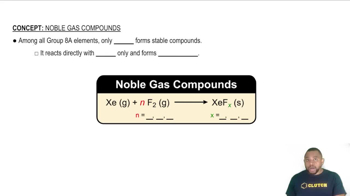
Noble Gas Compounds

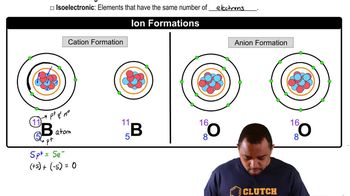
Ion Formation

Ion formation occurs when atoms gain or lose electrons to achieve a more stable electronic configuration. Cations are positively charged ions formed by losing electrons, while anions are negatively charged ions formed by gaining electrons. In the case of sulfur, it typically forms an anion (S²⁻) by gaining two electrons to reach a stable noble gas configuration.
Video consigliato:

Charge of Ions

The charge of an ion is determined by the difference between the number of protons and electrons in an atom. A neutral atom has equal numbers of protons and electrons, but when it gains or loses electrons, it becomes charged. For sulfur, when it gains two electrons to form S²⁻, it has a net charge of -2, indicating it has two more electrons than protons.
Video consigliato:
Percorso guidato
01:39
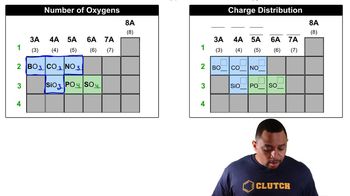
Polyatomic Ion Charges