Ch.6 - Ionic Compounds: Periodic Trends and Bonding Theory
McMurry - Chemistry 8th Edition
McMurry8th EditionChemistryISBN: 9781292336145Non è quello che usi tu?Cambia libro di testo
Capitolo 6, Problema 123

Which atom in each of the following pairs has a larger radius? (a) C or Ge (b) Ni or Pt (c) Sn or I (d) Na or Rb

Guida verificata passo dopo passo
1
Step 1: Understand that atomic radius generally increases as you move down a group in the periodic table because additional electron shells are added, making the atom larger.
Step 2: Recognize that atomic radius generally decreases as you move across a period from left to right due to the increase in nuclear charge, which pulls the electrons closer to the nucleus.
Step 3: For pair (a) C or Ge, identify that both elements are in Group 14, but Ge is below C in the periodic table, indicating Ge has a larger atomic radius.
Step 4: For pair (b) Ni or Pt, note that both elements are in Group 10, with Pt being below Ni, suggesting Pt has a larger atomic radius.
Step 5: For pair (c) Sn or I, observe that Sn is in Group 14 and I is in Group 17. Sn is to the left of I and also below it, indicating Sn has a larger atomic radius. For pair (d) Na or Rb, both are in Group 1, with Rb below Na, so Rb has a larger atomic radius.

Risposta video verificata per un problema simile:

Questa soluzione video è stata consigliata dai nostri tutor come utile per risolvere questo problema.
Durata del video:
2m

Concetti chiave

Ecco i concetti essenziali che devi comprendere per rispondere correttamente alla domanda.

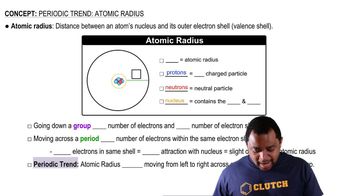
Atomic Radius

Atomic radius is the distance from the nucleus of an atom to the outermost shell of electrons. It generally increases down a group in the periodic table due to the addition of electron shells, which outweighs the increase in nuclear charge. Conversely, atomic radius decreases across a period from left to right as increased nuclear charge pulls electrons closer to the nucleus.
Video consigliato:

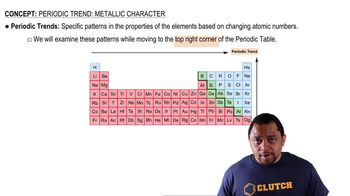
Periodic Trends

Periodic trends refer to the predictable patterns observed in the properties of elements as you move across or down the periodic table. Key trends include atomic radius, ionization energy, and electronegativity. Understanding these trends helps in predicting the behavior of elements in chemical reactions and their relative sizes.
Video consigliato:
Percorso guidato
00:38
Periodic Trends

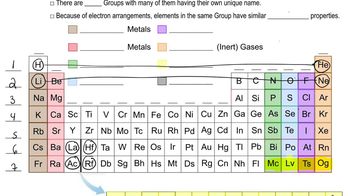
Group and Period Relationships

Elements are organized into groups (columns) and periods (rows) in the periodic table. Elements in the same group share similar properties and have the same number of valence electrons, while elements in the same period have the same number of electron shells. This organization is crucial for understanding how atomic size varies among different elements.
Video consigliato:
Percorso guidato
05:33
Periodic Table: Group Names