Ch.6 - Ionic Compounds: Periodic Trends and Bonding Theory
McMurry - Chemistry 8th Edition
McMurry8th EditionChemistryISBN: 9781292336145Non è quello che usi tu?Cambia libro di testo
Capitolo 6, Problema 5

Which of the following processes requires the largest input of energy? (LO 6.5) (a) (b) (c) (d)

Guida verificata passo dopo passo
1
Identify the type of processes listed in options (a), (b), (c), and (d). Determine if they involve breaking bonds, forming bonds, phase changes, or other energy transformations.
Recall that breaking chemical bonds generally requires an input of energy, while forming bonds releases energy. Similarly, phase changes from solid to liquid or liquid to gas typically require energy input.
Compare the energy changes associated with each process. Processes that involve breaking stronger bonds or phase changes that require overcoming significant intermolecular forces typically need more energy.
Consider any additional information provided in the problem or your knowledge of specific substances involved in the processes to assess which might have the highest energy requirement.
Select the option that involves the process with the highest energy barrier, such as breaking the strongest bonds or the phase change requiring the most energy to overcome intermolecular forces.

Risposta video verificata per un problema simile:

Questa soluzione video è stata consigliata dai nostri tutor come utile per risolvere questo problema.
Durata del video:
1m

Concetti chiave

Ecco i concetti essenziali che devi comprendere per rispondere correttamente alla domanda.

Energy in Chemical Processes

In chemistry, energy is a crucial factor in determining the feasibility and rate of chemical reactions. Different processes, such as phase changes, bond breaking, and formation, require varying amounts of energy. Understanding the energy requirements helps predict which processes are more or less favorable under specific conditions.
Video consigliato:

Endothermic vs. Exothermic Reactions

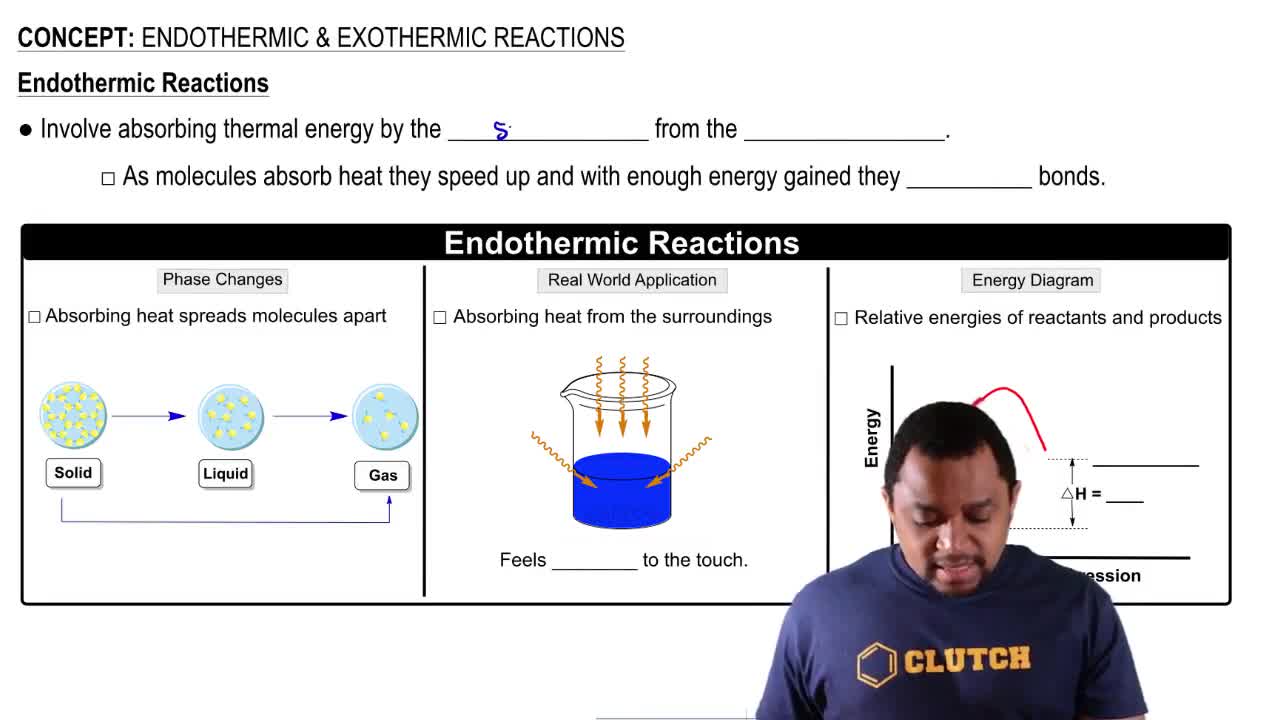
Reactions can be classified as endothermic or exothermic based on their energy exchange with the surroundings. Endothermic reactions absorb energy, often requiring a significant input to proceed, while exothermic reactions release energy. Recognizing these types is essential for evaluating which processes demand the most energy.
Video consigliato:
Percorso guidato
02:30
Endothermic & Exothermic Reactions

Activation Energy

Activation energy is the minimum energy required for a chemical reaction to occur. It represents the energy barrier that must be overcome for reactants to transform into products. Processes with higher activation energies typically require larger energy inputs, making this concept vital for understanding which reactions are more energy-intensive.
Video consigliato:
Percorso guidato
02:02
Activity Series Chart