Ch.7 - Covalent Bonding and Electron-Dot Structures
McMurry - Chemistry 8th Edition
McMurry8th EditionChemistryISBN: 9781292336145Non è quello che usi tu?Cambia libro di testo
Capitolo 7, Problema 90

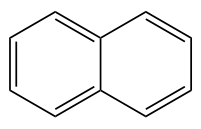
Benzene has the following structural formula. Structural formula of benzene showing its carbon-carbon bonds for resonance structures.
(b) Which statement best describes the carbon–carbon bonds in benzene? (i) Three carbon–carbon bonds are longer and weaker than the other three carbon–carbon bonds. (ii) All six carbon–carbon bonds are identical, and their length and strength are between a double and single bond. (iii) The length of carbon–carbon double bond switches back and forth between the length of a double and a single bond.

Guida verificata passo dopo passo
1
Step 1: Understand the structure of benzene. Benzene is a cyclic hydrocarbon with the molecular formula C6H6. It has a ring structure with alternating double and single bonds between carbon atoms.
Step 2: Recognize the concept of resonance in benzene. Benzene exhibits resonance, meaning that the electrons are delocalized over the entire ring structure, creating a hybrid of the possible resonance structures.
Step 3: Analyze the given statements. Statement (i) suggests that three carbon–carbon bonds are longer and weaker than the other three, which is not consistent with the resonance structure of benzene.
Step 4: Evaluate statement (ii). This statement suggests that all six carbon–carbon bonds are identical, with lengths and strengths between those of a single and double bond, which aligns with the concept of resonance in benzene.
Step 5: Consider statement (iii). This statement suggests that the length of the carbon–carbon double bond switches back and forth, which is not accurate for benzene as the bonds are delocalized and do not switch.

Risposta video verificata per un problema simile:

Questa soluzione video è stata consigliata dai nostri tutor come utile per risolvere questo problema.
Durata del video:
4m

Concetti chiave

Ecco i concetti essenziali che devi comprendere per rispondere correttamente alla domanda.

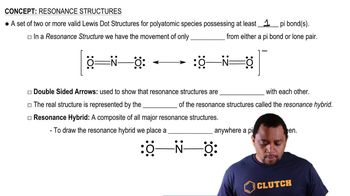
Resonance Structures

Resonance structures are different ways of drawing the same molecule that illustrate the delocalization of electrons. In benzene, the electrons in the carbon-carbon bonds are not fixed in one position but are spread out over the entire ring, leading to equivalent structures. This concept helps explain the stability and unique properties of benzene compared to alkenes.
Video consigliato:
Percorso guidato
01:42
Resonance Structures

Bond Length and Strength

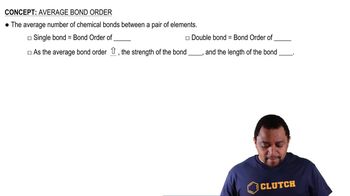
In chemistry, bond length refers to the distance between the nuclei of two bonded atoms, while bond strength indicates the energy required to break that bond. In benzene, all carbon-carbon bonds are of equal length and strength, which is intermediate between single (longer, weaker) and double (shorter, stronger) bonds due to resonance, resulting in a stable structure.
Video consigliato:
Percorso guidato
00:36
Average Bond Order

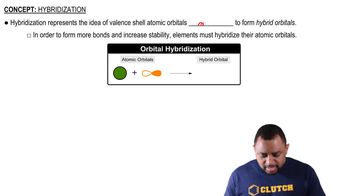
Hybridization

Hybridization is the concept of mixing atomic orbitals to form new hybrid orbitals that can accommodate bonding. In benzene, the carbon atoms are sp² hybridized, which allows for the formation of three sigma bonds and one unhybridized p orbital. This p orbital participates in the delocalized pi bonding that characterizes the resonance in benzene.
Video consigliato: