
Ch.7 - Covalent Bonding and Electron-Dot Structures
McMurry - Chemistry 8th Edition
McMurry8th EditionChemistryISBN: 9781292336145Non è quello che usi tu?Cambia libro di testo
Capitolo 7, Problema 85b

Draw as many resonance structures as you can for the following nitrogen-containing compounds. Not all will obey the octet rule. Use curved arrows to depict the conversion of one structure into another. (b) NO

Guida verificata passo dopo passo
1
Identify the valence electrons for nitrogen (N) and oxygen (O). Nitrogen typically has 5 valence electrons and oxygen has 6.
Draw the Lewis structure of NO. Start by connecting N and O with a single bond. Assign the remaining electrons to fulfill the octet as much as possible, keeping in mind that NO is a radical with an odd number of electrons.
Consider the possible locations for the unpaired electron. It can be placed on nitrogen or oxygen. This will affect the placement of double bonds and the formal charges in the resonance structures.
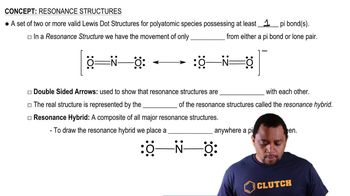
Draw resonance structures by moving the unpaired electron and pi electrons between N and O. Use curved arrows to show the movement of electrons from one structure to another, indicating the conversion between different resonance forms.
Evaluate the formal charges in each resonance structure to ensure they are minimized and check if all atoms (as much as possible) follow the octet rule, although in radicals like NO, the octet rule might not be fully obeyed.

Risposta video verificata per un problema simile:

Questa soluzione video è stata consigliata dai nostri tutor come utile per risolvere questo problema.
Durata del video:
4m

Concetti chiave

Ecco i concetti essenziali che devi comprendere per rispondere correttamente alla domanda.

Resonance Structures

Resonance structures are different ways of drawing the same molecule that illustrate the delocalization of electrons. They are used to represent molecules where a single Lewis structure cannot adequately depict the electron distribution. Each resonance structure contributes to the overall hybrid structure, which is a more accurate representation of the molecule's actual electron configuration.
Video consigliato:
Percorso guidato
01:42
Resonance Structures

Octet Rule

The octet rule is a chemical guideline stating that atoms tend to bond in such a way that they each have eight electrons in their valence shell, achieving a stable electron configuration similar to that of noble gases. While many elements follow this rule, some, like nitrogen in certain compounds, may have fewer or more than eight electrons due to resonance or other bonding scenarios.
Video consigliato:

Curved Arrows in Resonance

Curved arrows are a notation used in organic chemistry to show the movement of electrons during the formation of resonance structures. The tail of the arrow indicates the starting point of the electron pair, while the head points to where the electrons are moving. This visual representation helps in understanding how different resonance forms are interrelated and how electron delocalization occurs within a molecule.
Video consigliato:
Percorso guidato
01:42
Resonance Structures
Pratica correlata
Domanda del libro di testo

Draw as many resonance structures as you can for the following nitrogen-containing compounds. Not all will obey the octet rule. Use curved arrows to depict the conversion of one structure into another. (d) N2O3(ONNO2)

759
views
Domanda del libro di testo
Which compound do you expect to have the stronger N-N bond, N2H2 or N2H4? Explain.
728
views
Domanda del libro di testo
Ibuprofen 1C13H18O22, marketed under such brand names as Advil and Motrin, is a drug sold over the counter for treatment of pain and inflammation. Complete the structure of ibuprofen by adding hydrogen atoms and lone pairs where needed.

965
views
Domanda del libro di testo
The estimated lattice energy for CsF21s2 is +2347 kJ/mol. Use the data given in Problem 6.86 to calculate an overall energy change in kilojoules per mole for the formation of CsF21s2 from its elements. Does the overall reaction absorb energy or release it? In light of your answer to Problem 6.86, which compound is more likely to form in the reaction of cesium with fluorine, CsF or CsF2?

1064
views
Domanda del libro di testo
Which of the following pairs of structures represent resonance forms, and which do not? (a)
762
views
Domanda del libro di testo
Calculate the energy change in kilojoules per mole when lithium atoms lose an electron to bromine atoms to form isolated Li+ and Br-ions. [The Ei for Li1g2 is 520 kJ/mol; the Eea for Br1g2 is -325 kJ/mol.] Will a lithium atom transfer an elec-tron to a bromine atom to form isolated Li+ 1g2 and Br-1g2 ions? Explain.
480
views