Ch.8 - Covalent Compounds: Bonding Theories and Molecular Structure
McMurry - Chemistry 8th Edition
McMurry8th EditionChemistryISBN: 9781292336145Non è quello che usi tu?Cambia libro di testo
Capitolo 8, Problema 115b

Cyclooctatetraene dianion, C8H82-, is an organic ion with the structure shown. Considering only the p bonds and not the s bonds, cyclooctatetraene dianion can be described by the following energy diagrams of its p molecular orbitals:
(b) Three of the p molecular orbitals are bonding, three are antibonding, and two are nonbonding, meaning that they have the same energy level as isolated p orbitals. Which is which?

Guida verificata passo dopo passo
1
Identify the total number of p electrons in the cyclooctatetraene dianion, C8H82-. Since each carbon atom contributes one p electron and there are two extra electrons due to the 2- charge, calculate the total number of p electrons.
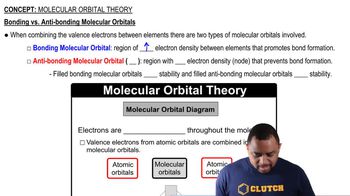
Understand the concept of bonding, antibonding, and nonbonding molecular orbitals. Bonding orbitals are lower in energy compared to the atomic orbitals of the isolated atoms, antibonding orbitals are higher in energy, and nonbonding orbitals have the same energy as the atomic orbitals.
Determine the filling of the molecular orbitals with the calculated number of p electrons, starting from the lowest energy orbital and moving to higher energy orbitals, following Pauli's exclusion principle and Hund's rule.
Identify which molecular orbitals are filled and which remain unfilled. The filled orbitals up to the number of available p electrons will indicate which are bonding, nonbonding, and antibonding.
Correlate the filled molecular orbitals with their energy levels to classify them as bonding, nonbonding, or antibonding based on their relative energies compared to the isolated p orbitals.

Risposta video verificata per un problema simile:

Questa soluzione video è stata consigliata dai nostri tutor come utile per risolvere questo problema.
Durata del video:
3m

Concetti chiave

Ecco i concetti essenziali che devi comprendere per rispondere correttamente alla domanda.

Molecular Orbitals

Molecular orbitals (MOs) are formed by the linear combination of atomic orbitals (LCAO) when atoms bond together. In the case of cyclooctatetraene dianion, the p orbitals combine to create bonding, antibonding, and nonbonding molecular orbitals. Bonding MOs lower the energy of the system, while antibonding MOs raise it. Nonbonding MOs have energies similar to the original atomic orbitals and do not contribute to bonding.
Video consigliato:
Percorso guidato
03:06
Molecular Orbital Theory

Bonding and Antibonding Orbitals

Bonding orbitals are formed when atomic orbitals combine constructively, leading to increased electron density between the nuclei, which stabilizes the molecule. Antibonding orbitals, on the other hand, result from destructive interference, creating a node between the nuclei and destabilizing the molecule. In cyclooctatetraene dianion, understanding which orbitals are bonding or antibonding is crucial for predicting the stability and reactivity of the ion.
Video consigliato:
Percorso guidato
03:06
Molecular Orbital Theory

Nonbonding Orbitals

Nonbonding orbitals are molecular orbitals that do not contribute to the bonding between atoms. They have energies similar to the atomic orbitals from which they are derived and are typically filled with electrons that do not participate in bonding interactions. In the context of cyclooctatetraene dianion, identifying the nonbonding orbitals is essential for understanding the electronic structure and properties of the ion, as they can influence its reactivity and stability.
Video consigliato:
Percorso guidato
03:06
Molecular Orbital Theory
Pratica correlata
Domanda del libro di testo
The water molecule has similar bond vibrations to carbon dioxide. Decide whether the symmetric, asymmetric, and bending vibrations in water will result in the absorption of IR radiation.
449
views

Domanda del libro di testo

Cyclooctatetraene dianion, C8H82-, is an organic ion with the structure shown. Considering only the p bonds and not the s bonds, cyclooctatetraene dianion can be described by the following energy diagrams of its p molecular orbitals:

(a) What is the hybridization of the 8 carbon atoms?

1074
views
Domanda del libro di testo

Cyclooctatetraene dianion, C8H82-, is an organic ion with the structure shown. Considering only the p bonds and not the s bonds, cyclooctatetraene dianion can be described by the following energy diagrams of its p molecular orbitals:

(c) Complete the MO energy diagram by assigning the appropriate numbers of p electrons to the various molecular orbitals, indicating the electrons using up/down arrows 1c T2.

664
views
Domanda del libro di testo
The dichromate ion, Cr2O72-, has neither Cr¬Cr nor O¬O bonds. (b) How many outer-shell electrons does each Cr atom have in your electron-dot structure? What is the likely geometry around the Cr atoms?
708
views
1
rank
Domanda del libro di testo
In the cyanate ion, OCN-, carbon is the central atom. (d) Which hybrid orbitals are used by the C atom, and how many p bonds does the C atom form?
1005
views
Domanda del libro di testo
Bond vibrations for the symmetric and asymmetric stretch in methane are illustrated below. Decide whether each vibration will result in the absorption of IR radiation. Arrows indicate the movement of atoms during the vibration.

479
views