

Ch.8 - Covalent Compounds: Bonding Theories and Molecular Structure
McMurry - Chemistry 8th Edition
McMurry8th EditionChemistryISBN: 9781292336145Non è quello che usi tu?Cambia libro di testo
Capitolo 8, Problema 34

Ethyl acetate, CH3CO2CH2CH3, is commonly used as a solvent and nail-polish remover. Look at the following electrostatic potential map of ethyl acetate, and explain the observed polarity.
Electrostatic potential map of ethyl acetate showing molecular polarity with color gradients.

Guida verificata passo dopo passo
1
Observe the electrostatic potential map of ethyl acetate. The color gradient indicates the distribution of electron density across the molecule.
Identify the regions of high electron density (red) and low electron density (blue). In the image, the red region is around the oxygen atom, indicating a high electron density.
Note that the blue region around the hydrogen atoms indicates a low electron density. This suggests that the oxygen atom is more electronegative and pulls electron density towards itself.
Understand that the difference in electron density creates a dipole moment, with the oxygen atom having a partial negative charge (δ-) and the hydrogen atoms having a partial positive charge (δ+).
Conclude that the observed polarity in ethyl acetate is due to the electronegativity difference between the oxygen and hydrogen atoms, resulting in a polar molecule with a dipole moment directed from the hydrogen atoms towards the oxygen atom.

Risposta video verificata per un problema simile:

Questa soluzione video è stata consigliata dai nostri tutor come utile per risolvere questo problema.
Durata del video:
1m

Concetti chiave

Ecco i concetti essenziali che devi comprendere per rispondere correttamente alla domanda.

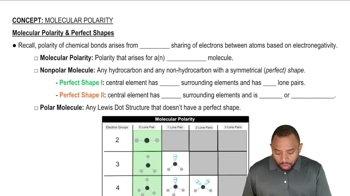
Molecular Polarity

Molecular polarity arises from the distribution of electron density within a molecule, leading to regions of partial positive and negative charge. In ethyl acetate, the presence of polar bonds, particularly between carbon and oxygen, creates a dipole moment, making the molecule polar. This polarity affects the molecule's interactions with other substances, influencing its behavior as a solvent.
Video consigliato:
Percorso guidato
02:38
Molecular Polarity

Electrostatic Potential Map

An electrostatic potential map visually represents the charge distribution within a molecule, using color gradients to indicate areas of positive and negative potential. In the case of ethyl acetate, the map shows regions where electron density is higher (negative potential) and lower (positive potential), helping to illustrate the molecule's polarity and how it interacts with other molecules.
Video consigliato:
Percorso guidato
00:34
Kinetic & Potential Energy

Functional Groups

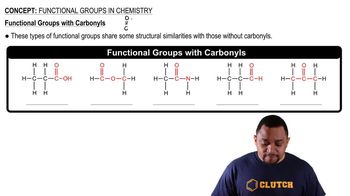
Functional groups are specific groups of atoms within molecules that determine their chemical properties and reactivity. Ethyl acetate contains an ester functional group (–COO–), which contributes to its polarity and solubility characteristics. Understanding functional groups is essential for predicting the behavior of organic compounds in various chemical contexts.
Video consigliato:
Percorso guidato
01:32
Carbonyl Functional Groups
Pratica correlata
Domanda del libro di testo

The following ball-and-stick molecular model is a representation of acetaminophen, the active ingredient in such over-thecounter headache remedies as Tylenol. (Red = O, gray = C, blue = N, ivory = H.) (a) What is the formula of acetaminophen?

556
views
Domanda del libro di testo

The following ball-and-stick molecular model is a representation of acetaminophen, the active ingredient in such over-thecounter headache remedies as Tylenol. (Red = O, gray = C, blue = N, ivory = H.) (b) Indicate the positions of the multiple bonds in acetaminophen.

814
views
Domanda del libro di testo

Two dichloroethylene molecules with the same chemical formula 1C2H2Cl22, but different arrangements of atoms are shown. (b) Which form of dichloroethylene has a dipole moment of 2.39 D, and which has a dipole moment of 0.00 D?

372
views
Domanda del libro di testo

The following ball-and-stick molecular model is a representation of thalidomide, a drug that causes birth defects when taken by expectant mothers but is valuable for its use against leprosy. The lines indicate only the connections between atoms, not whether the bonds are single, double, or triple. 1Red = O, gray = C, blue = N, ivory = H.2 (a) What is the formula of thalidomide?

332
views
Domanda del libro di testo
What geometric arrangement of charge clouds do you expect for atoms that have the following number of charge clouds? (a) 3 (b) 5 (c) 2 (d) 6
511
views
Domanda del libro di testo
What shape do you expect for molecules that meet the following descriptions? (a) A central atom with two lone pairs and three bonds to other atoms (b) A central atom with two lone pairs and two bonds to other atoms (c) A central atom with two lone pairs and four bonds to other atoms
603
views