Ch.8 - Covalent Compounds: Bonding Theories and Molecular Structure
McMurry - Chemistry 8th Edition
McMurry8th EditionChemistryISBN: 9781292336145Non è quello che usi tu?Cambia libro di testo
Capitolo 8, Problema 40

How many charge clouds are there around the central atom in molecules that have the following geometry? (a) Tetrahedral (b) Octahedral (c) Bent (d) Linear (e) Square pyramidal (f) Trigonal pyramidal

Guida verificata passo dopo passo
1
Identify the central atom in each molecular geometry and consider all regions of electron density (bonds and lone pairs) around it as charge clouds.
For a tetrahedral geometry, recognize that it involves four bonds and no lone pairs on the central atom, resulting in four charge clouds.
In an octahedral geometry, note that there are six bonds and no lone pairs on the central atom, leading to six charge clouds.
Consider a bent molecular geometry, which typically arises from a trigonal planar arrangement with one lone pair or a tetrahedral arrangement with two lone pairs. Count the total number of bonds and lone pairs to determine the charge clouds.
For linear and square pyramidal geometries, count the number of bonds and lone pairs around the central atom. Linear typically has two charge clouds (two bonds or one bond and one lone pair), while square pyramidal has five bonds and no lone pairs, resulting in five charge clouds.

Risposta video verificata per un problema simile:

Questa soluzione video è stata consigliata dai nostri tutor come utile per risolvere questo problema.
Durata del video:
2m

Concetti chiave

Ecco i concetti essenziali che devi comprendere per rispondere correttamente alla domanda.

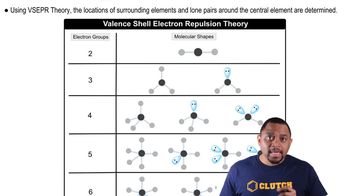
VSEPR Theory

Valence Shell Electron Pair Repulsion (VSEPR) Theory is a model used to predict the geometry of molecules based on the repulsion between electron pairs around a central atom. According to this theory, electron pairs, whether bonding or lone pairs, will arrange themselves to minimize repulsion, leading to specific molecular shapes.
Video consigliato:
Percorso guidato
02:13
Molecular Shapes and VSEPR

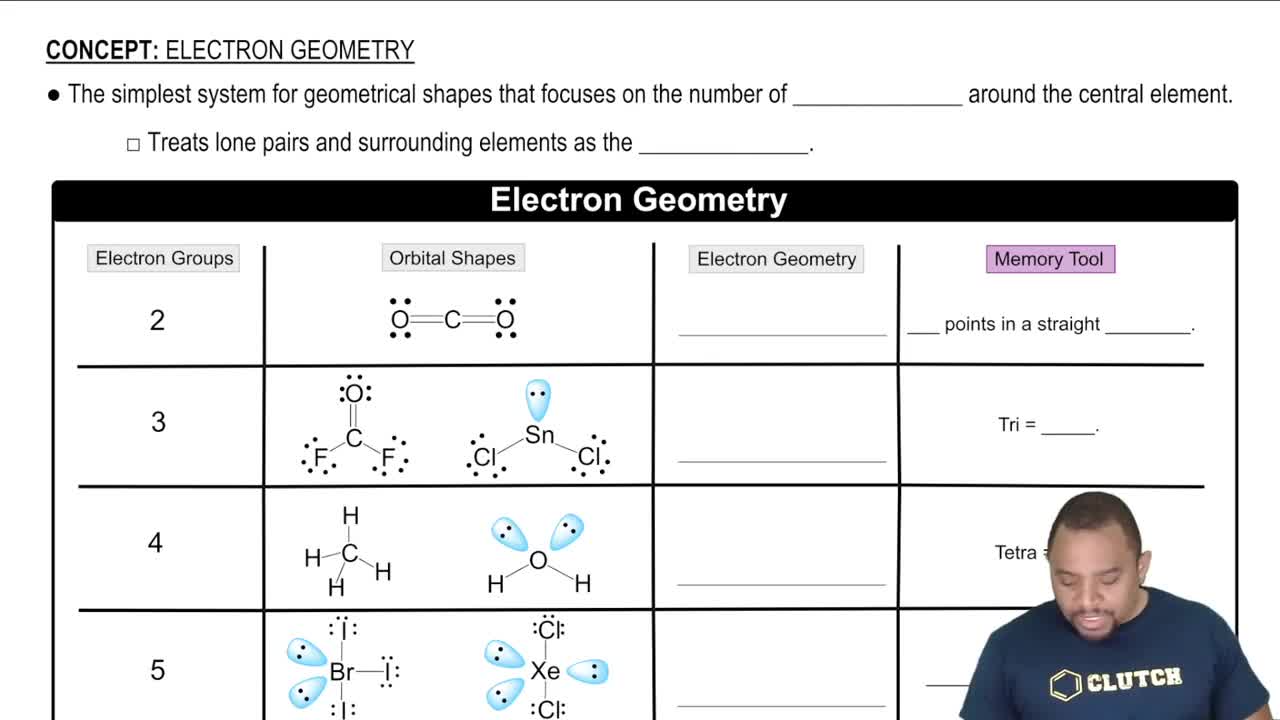
Electron Cloud

An electron cloud refers to the regions around a central atom where electrons are likely to be found. In the context of molecular geometry, each region of electron density, including bonding pairs and lone pairs, is considered a 'charge cloud' that influences the spatial arrangement of atoms in a molecule.
Video consigliato:
Percorso guidato
04:44
Electron Geometry

Molecular Geometry

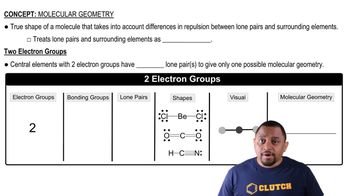
Molecular geometry describes the three-dimensional arrangement of atoms in a molecule. Different geometries, such as tetrahedral, octahedral, bent, linear, square pyramidal, and trigonal pyramidal, arise from the number and arrangement of charge clouds around the central atom, affecting the molecule's shape and properties.
Video consigliato:
Percorso guidato
01:33
Molecular Geometry with Two Electron Groups
Pratica correlata
Domanda del libro di testo
What bond angles do you expect for each of the following? (d) The O¬B¬O angle in BO33-
628
views

Domanda del libro di testo

Two dichloroethylene molecules with the same chemical formula 1C2H2Cl22, but different arrangements of atoms are shown. (b) Which form of dichloroethylene has a dipole moment of 2.39 D, and which has a dipole moment of 0.00 D?

372
views
Domanda del libro di testo
A potential replacement for the chlorofluorocarbon refrigerants that harm the Earth's protective ozone layer is a compound called E143a, or trifluoromethyl methyl ether, F3COCH3. Draw an electron-dot structure for F3COCH3, and predict the geometry around both the carbons and the oxygen.
367
views
Domanda del libro di testo
What geometric arrangement of charge clouds do you expect for atoms that have the following number of charge clouds? (a) 3 (b) 5 (c) 2 (d) 6
511
views
Domanda del libro di testo
What shape do you expect for molecules that meet the following descriptions? (a) A central atom with two lone pairs and three bonds to other atoms (b) A central atom with two lone pairs and two bonds to other atoms (c) A central atom with two lone pairs and four bonds to other atoms
603
views
Domanda del libro di testo
Oceanographers study the mixing of water masses by releasing tracer molecules at a site and then detecting their presence at other places. The molecule trifluoromethylsulfur pentafluoride is one such tracer. Draw an electron-dot structure for CF3SF5, and predict the bond angles around both carbon and sulfur.
411
views