
Ch.8 - Covalent Compounds: Bonding Theories and Molecular Structure
McMurry - Chemistry 8th Edition
McMurry8th EditionChemistryISBN: 9781292336145Non è quello che usi tu?Cambia libro di testo
Capitolo 8, Problema 31

The VSEPR model is a simple predictive tool that is usually, but not always, correct. Take urea, for instance, a waste product excreted in animal urine: 3D model of urea showing atoms: red for O, gray for C, blue for N, ivory for H.
What hybridization would you expect for the C and N atoms in urea according to the VSEPR model, and what approximate values would you expect for the various bond angles? What are the actual hybridizations and bond angles based on the molecular model shown? 1Red = O, gray = C, blue = N, ivory = H.2

Guida verificata passo dopo passo
1
Identify the central atoms in the urea molecule: carbon (C) and nitrogen (N).
Determine the steric number for each central atom. For carbon, count the number of atoms bonded to it and lone pairs. For nitrogen, do the same.
Use the steric number to predict the hybridization of each central atom. A steric number of 4 indicates sp3 hybridization, 3 indicates sp2, and 2 indicates sp hybridization.
Predict the bond angles based on the hybridization. For sp3, the bond angles are approximately 109.5 degrees; for sp2, they are approximately 120 degrees; and for sp, they are approximately 180 degrees.
Compare the predicted hybridizations and bond angles with the actual molecular model. In the model, observe the geometry around the carbon and nitrogen atoms to determine the actual hybridizations and bond angles.

Risposta video verificata per un problema simile:

Questa soluzione video è stata consigliata dai nostri tutor come utile per risolvere questo problema.
Durata del video:
3m

Concetti chiave

Ecco i concetti essenziali che devi comprendere per rispondere correttamente alla domanda.

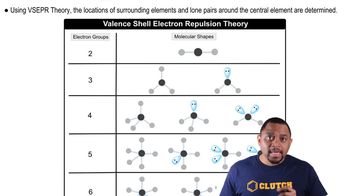
VSEPR Theory

The Valence Shell Electron Pair Repulsion (VSEPR) theory is a model used to predict the geometry of molecules based on the repulsion between electron pairs in the valence shell of atoms. According to this theory, electron pairs will arrange themselves to minimize repulsion, leading to specific molecular shapes. For urea, this model helps in predicting the arrangement of atoms around the central carbon and nitrogen atoms.
Video consigliato:
Percorso guidato
02:13
Molecular Shapes and VSEPR

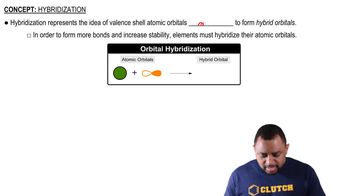
Hybridization

Hybridization is the concept of mixing atomic orbitals to form new hybrid orbitals that can accommodate the bonding requirements of a molecule. In urea, the carbon atom is typically sp² hybridized, while the nitrogen atom is sp³ hybridized. This hybridization influences the bond angles and the overall geometry of the molecule, which can be analyzed using the VSEPR model.
Video consigliato:

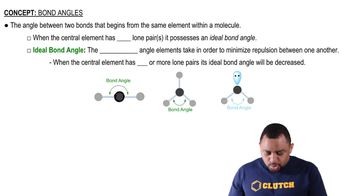
Bond Angles

Bond angles are the angles formed between adjacent bonds in a molecule, which are influenced by the hybridization of the atoms involved. In urea, the expected bond angles based on the VSEPR model would be approximately 120° for the sp² hybridized carbon and 109.5° for the sp³ hybridized nitrogen. However, actual bond angles may vary slightly due to factors such as lone pair repulsion and the presence of different atoms.
Video consigliato:
Pratica correlata
Domanda del libro di testo

The following ball-and-stick molecular model is a representation of acetaminophen, the active ingredient in such over-thecounter headache remedies as Tylenol. (Red = O, gray = C, blue = N, ivory = H.) (a) What is the formula of acetaminophen?

556
views
Domanda del libro di testo

The following ball-and-stick molecular model is a representation of acetaminophen, the active ingredient in such over-thecounter headache remedies as Tylenol. (Red = O, gray = C, blue = N, ivory = H.) (b) Indicate the positions of the multiple bonds in acetaminophen.

814
views
Domanda del libro di testo
The C2 molecule has a MO diagram similar to N2 (Figure 8.22a). What is the bond order of C2 and is it paramagnetic or diamagnetic? (LO 8.12) (a) Bond order = 2, diamagnetic (b) Bond order = 2, paramagnetic (c) Bond order = 0, paramagnetic (d) Bond order = 3>2, diamagnetic
1048
views
Domanda del libro di testo

Three of the following molecular models have a tetrahedral central atom, and one does not. Which is the odd one? (There may be a 'hidden' atom directly behind a visible atom in some cases.) (a)

(b)

(c)

(d)

494
views
Domanda del libro di testo
The following ball-and-stick molecular model is a representation of acetaminophen, the active ingredient in such over-thecounter headache remedies as Tylenol. 1Red = O, gray = C, blue = N, ivory = H.2 (c) What is the geometry around each carbon?

546
views
Domanda del libro di testo
What is the geometry around the central atom in each of the following molecular models? (a)

676
views