
Ch.9 - Thermochemistry: Chemical Energy
McMurry - Chemistry 8th Edition
McMurry8th EditionChemistryISBN: 9781292336145Non è quello che usi tu?Cambia libro di testo
Capitolo 9, Problema 153a

(a) Write a balanced equation for the reaction of potassium metal with water.

Guida verificata passo dopo passo
1
Identify the reactants and products: Potassium (K) reacts with water (H2O) to form potassium hydroxide (KOH) and hydrogen gas (H2).
Write the unbalanced chemical equation: K + H2O -> KOH + H2.
Balance the equation by adjusting coefficients to ensure the same number of each type of atom on both sides of the equation.
Start by balancing the potassium atoms: Place a coefficient of 2 in front of K and KOH to balance potassium.
Balance the hydrogen and oxygen atoms: Adjust the coefficient of H2O to ensure the number of hydrogen and oxygen atoms are equal on both sides.

Risposta video verificata per un problema simile:

Questa soluzione video è stata consigliata dai nostri tutor come utile per risolvere questo problema.
Durata del video:
1m

Concetti chiave

Ecco i concetti essenziali che devi comprendere per rispondere correttamente alla domanda.

Chemical Reactions

A chemical reaction involves the transformation of reactants into products through the breaking and forming of chemical bonds. In this context, the reaction between potassium metal and water is a type of single displacement reaction, where potassium displaces hydrogen from water, leading to the formation of potassium hydroxide and hydrogen gas.
Video consigliato:
Percorso guidato
03:31
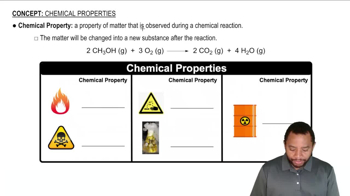
Chemical Properties

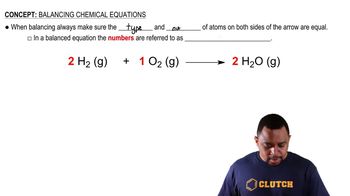
Balancing Chemical Equations

Balancing a chemical equation ensures that the number of atoms for each element is the same on both sides of the equation, adhering to the law of conservation of mass. This process involves adjusting coefficients in front of the chemical formulas to achieve equal numbers of each type of atom, which is crucial for accurately representing the reaction.
Video consigliato:
Percorso guidato
01:32
Balancing Chemical Equations

Reactivity of Alkali Metals

Alkali metals, such as potassium, are highly reactive, especially with water. When potassium reacts with water, it produces potassium hydroxide and hydrogen gas, often resulting in an exothermic reaction that can ignite the hydrogen gas. Understanding the reactivity of these metals is essential for predicting the products and safety measures during the reaction.
Video consigliato:
Percorso guidato
03:12
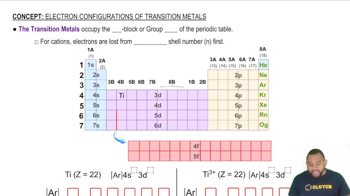
Transition Metals
Pratica correlata
Domanda del libro di testo

Acid spills are often neutralized with sodium carbonate or sodium hydrogen carbonate. For neutralization of acetic acid, the unbalanced equations are

(1) CH3CO2H(l) + Na2CO3(s) → CH3CO2Na(aq) + CO2(g) + H2O(l)

(2) CH3CO2H(l) + NaHCO3(s) → CH3CO2Na(aq) + CO2(g) + H2O(l)

(a) Balance both equations.

689
views
Domanda del libro di testo

Acid spills are often neutralized with sodium carbonate or sodium hydrogen carbonate. For neutralization of acetic acid, the unbalanced equations are

(1) CH3CO2H(l) + Na2CO3(s) → CH3CO2Na(aq) + CO2(g) + H2O(l)

(2) CH3CO2H(l) + NaHCO3(s) → CH3CO2Na(aq) + CO2(g) + H2O(l)

(b) How many kilograms of each substance is needed to neutralize a 1.000-gallon spill of pure acetic acid (density = 1.049 g/mL)?

1508
views
Domanda del libro di testo

(d) What is the molarity of the KOH solution prepared in part (c), and how many milliliters of 0.554 M H2SO4 are required to neutralize it?

715
views
Domanda del libro di testo
Acid spills are often neutralized with sodium carbonate or sodium hydrogen carbonate. For neutralization of acetic acid, the unbalanced equations are 112 CH3CO2H1l2 + Na2CO31s2 S CH3CO2Na1aq2 + CO21g2 + H2O1l2 122 CH3CO2H1l2 + NaHCO31s2 CH3CO2Na1aq2 + CO21g2 + H2O1l2 (c) How much heat in kilojoules is absorbed or liberated in each reaction? See Appendix B for standard heats of for- mation; ΔH°f = - 726.1 kJ>mol for CH3CO2 Na(aq).
645
views
Domanda del libro di testo

(b) Use the data in Appendix B to calculate ΔH° for the reaction of potassium metal with water.

1136
views
Domanda del libro di testo

(c) Assume that a chunk of potassium weighing 7.55 g is dropped into 400.0 g of water at 25.0 °C. What is the final temperature of the water if all the heat released is used to warm the water?

390
views