Ch.9 - Thermochemistry: Chemical Energy
McMurry - Chemistry 8th Edition
McMurry8th EditionChemistryISBN: 9781292336145Non è quello che usi tu?Cambia libro di testo
Capitolo 9, Problema 63

Assume that a particular reaction evolves 244 kJ of heat and that 35 kJ of PV work is gained by the system. What are the values of ∆E and ∆H for the system? For the surroundings?

Guida verificata passo dopo passo
1
Identify the given values: the heat evolved by the reaction is 244 kJ, and the PV work done on the system is 35 kJ.
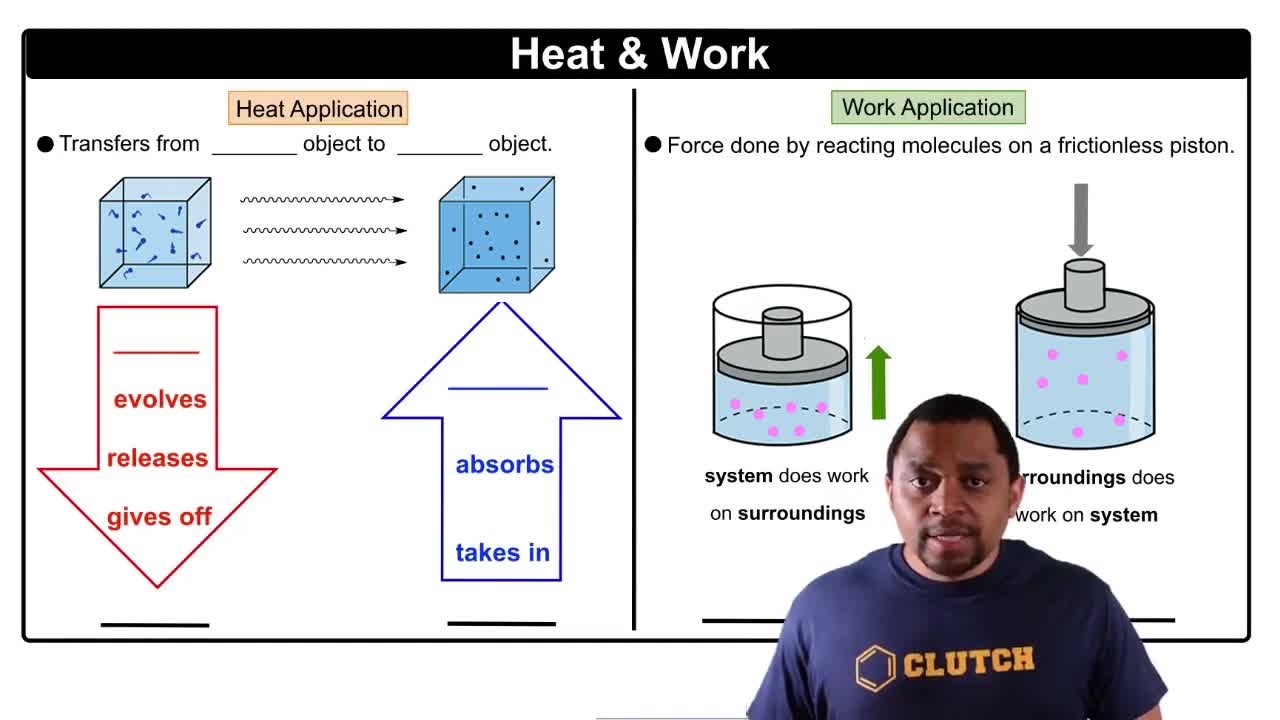
Recall the first law of thermodynamics, which states that the change in internal energy (\( \Delta E \)) of a system is the sum of the heat exchanged (q) and the work done (w) on the system: \( \Delta E = q + w \).
Since the reaction evolves heat, the heat exchanged (q) is -244 kJ (exothermic process). The work done on the system (w) is +35 kJ.
Substitute the values into the equation \( \Delta E = q + w \) to find the change in internal energy for the system.
To find the change in enthalpy (\( \Delta H \)), use the relation \( \Delta H = \Delta E + P\Delta V \). Since \( P\Delta V \) is the work done, \( \Delta H = q \) for processes at constant pressure, so \( \Delta H = -244 \text{ kJ} \).

Risposta video verificata per un problema simile:

Questa soluzione video è stata consigliata dai nostri tutor come utile per risolvere questo problema.
Durata del video:
2m

Concetti chiave

Ecco i concetti essenziali che devi comprendere per rispondere correttamente alla domanda.

First Law of Thermodynamics

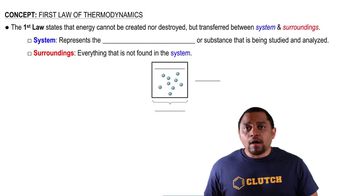
The First Law of Thermodynamics states that energy cannot be created or destroyed, only transformed from one form to another. In a closed system, the change in internal energy (∆E) is equal to the heat added to the system minus the work done by the system. This principle is fundamental for understanding how energy transfers occur during chemical reactions.
Video consigliato:
Percorso guidato
01:18
First Law of Thermodynamics

Enthalpy (∆H)

Enthalpy (H) is a thermodynamic quantity that represents the total heat content of a system. The change in enthalpy (∆H) is used to quantify the heat absorbed or released during a reaction at constant pressure. It is calculated as the sum of the internal energy change (∆E) and the product of pressure and volume change (P∆V), making it essential for evaluating heat exchanges in chemical processes.
Video consigliato:
Percorso guidato
02:34
Enthalpy of Formation

Work and Heat in Thermodynamics

In thermodynamics, work and heat are two primary ways energy can be transferred between a system and its surroundings. Work (W) is the energy transferred when a force is applied over a distance, while heat (q) is the energy transferred due to a temperature difference. Understanding how to account for these forms of energy transfer is crucial for calculating changes in internal energy and enthalpy in chemical reactions.
Video consigliato:
Percorso guidato
02:50
First Law of Thermodynamics