Ch.9 - Thermochemistry: Chemical Energy
McMurry - Chemistry 8th Edition
McMurry8th EditionChemistryISBN: 9781292336145Non è quello che usi tu?Cambia libro di testo
Capitolo 9, Problema 52

Assume that the nutritional content of an apple-say, 50 Cal (1 Cal = 1000 cal) - could be used to light a light bulb. For how many minutes would there be light from each of the following? (a) A 100-watt incandescent bulb (1 W = 1 J/s)

Guida verificata passo dopo passo
1
Step 1: Convert the energy content of the apple from Calories to Joules. Remember that 1 Calorie (Cal) is equivalent to 4184 Joules (J).
Step 2: Convert the power of the light bulb from Watts to Joules per second. Remember that 1 Watt (W) is equivalent to 1 Joule per second (J/s).
Step 3: Calculate the total time the light bulb can be lit by dividing the total energy content of the apple (in Joules) by the power of the light bulb (in Joules per second). This will give you the total time in seconds.
Step 4: Convert the total time from seconds to minutes by dividing by 60, since there are 60 seconds in a minute.
Step 5: The result from step 4 is the total time the light bulb can be lit using the energy from the apple.

Risposta video verificata per un problema simile:

Questa soluzione video è stata consigliata dai nostri tutor come utile per risolvere questo problema.
Durata del video:
3m

Concetti chiave

Ecco i concetti essenziali che devi comprendere per rispondere correttamente alla domanda.

Energy Conversion

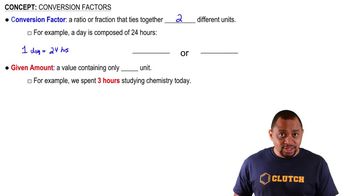
Energy conversion refers to the process of changing energy from one form to another. In this context, the nutritional energy from the apple, measured in calories, is converted into electrical energy to power a light bulb. Understanding how to convert calories to joules (1 Cal = 4184 J) is essential for calculating the total energy available for lighting.
Video consigliato:
Percorso guidato
01:56
Conversion Factors

Power and Energy Relationship

Power is the rate at which energy is used or produced, measured in watts (W), where 1 W = 1 J/s. To determine how long a light bulb can operate on a given amount of energy, one must understand the relationship between total energy available and the power rating of the bulb. This relationship allows us to calculate the duration of light by dividing the total energy by the power consumption of the bulb.
Video consigliato:
Percorso guidato
04:42
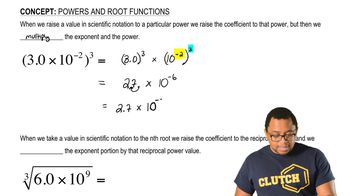
Power and Root Functions Example

Unit Conversion

Unit conversion is the process of converting a quantity expressed in one set of units to another. In this problem, it is crucial to convert the energy from calories to joules and understand the relationship between watts and joules per second. Mastery of unit conversion ensures accurate calculations and helps in understanding how different units relate to each other in the context of energy and power.
Video consigliato:
Percorso guidato
01:56
Conversion Factors
Pratica correlata
Domanda del libro di testo
Calculate the work done in joules by a chemical reaction if the volume increases from 3.2 L to 3.4 L against a constant external pressure of 3.6 atm. What is the sign of the energy change?
2140
views
1
rank

Domanda del libro di testo

A reaction inside a cylindrical container with a movable RAN piston causes the volume to change from 12.0 L to 18.0 L while the pressure outside the container remains constant at 0.975 atm. (The volume of a cylinder is V = pr2h, where h is the height; 1 L # atm = 101.325 J.) (a) What is the value in joules of the work w done during the reaction?

619
views
Domanda del libro di testo

A reaction inside a cylindrical container with a movable RAN piston causes the volume to change from 12.0 L to 18.0 L while the pressure outside the container remains constant at 0.975 atm. (The volume of a cylinder is V = pr2h, where h is the height; 1 L # atm = 101.325 J.) (b) The diameter of the piston is 17.0 cm. How far does the piston move?

720
views
Domanda del libro di testo

At a constant pressure of 0.905 atm, a chemical reaction takes place in a cylindrical container with a movable piston having a diameter of 40.0 cm. During the reaction, the height of the piston drops by 65.0 cm. (The volume of a cylinder is V=pr2h,wherehistheheight;1Latm=101.3J.) (a) What is the change in volume in liters during the reaction?

898
views
Domanda del libro di testo
Which of the following are state functions, and which are not? (a) The temperature of an ice cube (b) The volume of an aerosol can (c) The amount of time required for Paula Radcliffe to run her world-record marathon: 2:15:25
525
views
Domanda del libro di testo
Assume that the kinetic energy of a 1400-kg car moving at 115 km/h (Problem 9.46) could be converted entirely into heat. What amount of water could be heated from 20 °C to 50 °C by the car's energy? 4.184 J are required to heat 1 g of water by 1 °C.
542
views