
Ch.9 - Thermochemistry: Chemical Energy
McMurry - Chemistry 8th Edition
McMurry8th EditionChemistryISBN: 9781292336145Non è quello che usi tu?Cambia libro di testo
Capitolo 9, Problema 80

Assuming that Coca-Cola has the saem specific heat as water [4.18 J/(g C)], calculate the amount of heat in kilojoules transferred when one can (about 350 g) is cooled from 25 C to 3 C.

Guida verificata passo dopo passo
1
Identify the mass of the Coca-Cola, which is given as 350 g.
Note the initial and final temperatures of the Coca-Cola, which are 25°C and 3°C, respectively.
Calculate the change in temperature (ΔT) by subtracting the final temperature from the initial temperature: ΔT = 25°C - 3°C.
Use the formula for heat transfer, Q = m * c * ΔT, where m is the mass, c is the specific heat capacity (4.18 J/(g°C) for water, and assumed for Coca-Cola), and ΔT is the change in temperature.
Convert the heat transfer from joules to kilojoules by dividing by 1000, since 1 kilojoule = 1000 joules.

Risposta video verificata per un problema simile:

Questa soluzione video è stata consigliata dai nostri tutor come utile per risolvere questo problema.
Durata del video:
1m

Concetti chiave

Ecco i concetti essenziali che devi comprendere per rispondere correttamente alla domanda.

Specific Heat Capacity

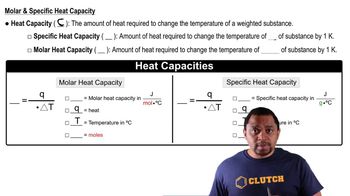
Specific heat capacity is the amount of heat required to raise the temperature of one gram of a substance by one degree Celsius. It is a crucial property that determines how much energy is needed to change the temperature of a material. In this case, Coca-Cola is assumed to have the same specific heat as water, which is 4.18 J/(g·°C), allowing for straightforward calculations of heat transfer.
Video consigliato:

Heat Transfer Calculation

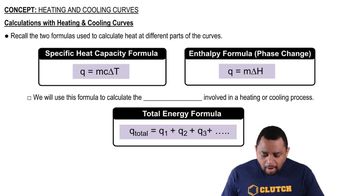
The heat transfer (q) can be calculated using the formula q = m × c × ΔT, where m is the mass of the substance, c is the specific heat capacity, and ΔT is the change in temperature. This formula allows us to quantify the energy exchanged during temperature changes, which is essential for solving the problem of cooling Coca-Cola from 25°C to 3°C.
Video consigliato:
Percorso guidato
01:05
Calculations with Heating and Cooling Curves

Units of Energy

Energy is often measured in joules (J) or kilojoules (kJ), where 1 kJ equals 1000 J. Understanding these units is important for converting the calculated heat transfer into the desired format. In this problem, the final answer should be expressed in kilojoules, necessitating a conversion from joules if the calculation yields a value in that unit.
Video consigliato:
Pratica correlata
Domanda del libro di testo
Titanium metal is used as a structural material in many high-tech applications, such as in jet engines. what is the specific heat of titanium in J/(g·°C) if it takes 89.7 J to raise the temeprature of a 33.0 g block of 5.20 °C? What is the molar heat capacity of titanium J/(mol·°C)?
1018
views
Domanda del libro di testo
Instant hot packs contain a solid and a pouch of water. When the pack is squeezed, the pouch breaks and the solid dis- solves, increasing the temperature because of the exothermic reaciton. The following reaction is used to make a hot pack: H2O LiCl1s2 ¡ Li 1aq2 + Cl 1aq2 ∆H = -36.9 kJ. What is the final temperature in a squeezed hot pack that contains 25.0 g of LiCl dissolved# in 125 mL of water? Assume a specific heat of 4.18 J>1g °C2 for the solution, an initial temperature of 25.0 °C, and no heat transfer between the hot pack and the environment.
1212
views
Domanda del libro di testo
Instant cold packs used to treat athletic injuries contain solid NH4NO3 and a pouch of water. When the pack is squeezed, the pouch breaks and the solid dissolves, lowering the tem-perature because of the endothermic reaction NH4NO31s2 ¡ NH4NO31aq2 ∆H = +25.7 kJ What is the final temperature in a squeezed cold pack that contains 50.0 g of NH4NO3 dissolved in 125 mL of water? Assume a specific heat of 4.18 J/(g C) for the solution, an initial temperature of 25.0 °C, and no heat transfer between the cold pack and the environment.
1652
views
Domanda del libro di testo
Sodium metal is sometimes used as a cooling agent in heat-exchange units because of its releatively high molar heat capacity fo 28.2 J/(mol·°C). What is the specific heat and molar heat capacity of sodium in J/g·°C?
1007
views
Domanda del libro di testo
Calculate the amount of heat required to raise the tempera- ture of 250.0 g (approximately 1 cup) of hot chocolate from 25.0 °C to 80.0 °C. Assume hot chocolate has the same spe-cific heat as water 34.18 J>1g °C24.
1398
views
Domanda del libro di testo
Does a measurement carried out in a bomb calorimeter give a value for ∆H or ∆E? Explain.
658
views