
Ch.9 - Thermochemistry: Chemical Energy
McMurry - Chemistry 8th Edition
McMurry8th EditionChemistryISBN: 9781292336145Non è quello che usi tu?Cambia libro di testo
Capitolo 9, Problema 150

Combustion analysis of 0.1500 g of methyl tert-butyl ether, an octane booster used in gasoline, gave 0.3744 g of CO2 and 0.1838 g of H2O. When a flask having a volume of 1.00 L was evacuated and then filled with methyl tertbutyl ether vapor at a pressure of 100.0 kPa and a temperature of 54.8 °C, the mass of the flask increased by 3.233 g. (d) The enthalpy of combustion for methyl tert-butyl ether is ΔH° combustion = -3368.7 kJ>mol. What is its standard enthalpy of enthalpy of formation, ΔH°f?

Guida verificata passo dopo passo
1
Calculate the moles of CO2 and H2O produced in the combustion using their molar masses. For CO2, the molar mass is approximately 44.01 g/mol and for H2O, it is approximately 18.02 g/mol.
Use the stoichiometry of the combustion reaction of methyl tert-butyl ether (MTBE) to determine the moles of MTBE that reacted. The balanced chemical equation for the combustion of MTBE is typically C5H12O + 7.5O2 -> 5CO2 + 6H2O.
Calculate the molar mass of MTBE by using the increase in mass of the flask when filled with MTBE vapor. Use the ideal gas law equation PV = nRT, where P is the pressure, V is the volume, n is the number of moles, R is the gas constant, and T is the temperature in Kelvin.
Calculate the enthalpy of combustion per mole of MTBE using the given ΔH° combustion and the moles of MTBE combusted.
Use Hess's Law to find the standard enthalpy of formation, ΔH°f, for MTBE. This involves using the enthalpies of formation for CO2 and H2O, and the enthalpy of combustion for MTBE. The equation is ΔH°f (MTBE) = ΔH° combustion (MTBE) + Σ[ΔH°f (products)] - Σ[ΔH°f (reactants)].

Risposta video verificata per un problema simile:

Questa soluzione video è stata consigliata dai nostri tutor come utile per risolvere questo problema.
Durata del video:
13m

Concetti chiave

Ecco i concetti essenziali che devi comprendere per rispondere correttamente alla domanda.

Combustion Analysis

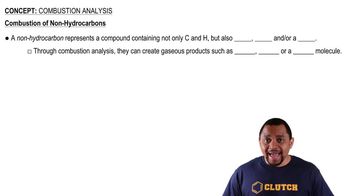
Combustion analysis is a technique used to determine the composition of a compound by burning it in excess oxygen and measuring the amounts of products formed, typically carbon dioxide (CO2) and water (H2O). The mass of these products allows for the calculation of the moles of carbon and hydrogen in the original compound, which is essential for determining empirical formulas and understanding the compound's combustion properties.
Video consigliato:
Percorso guidato
01:29
Combustion of Non-Hydrocarbons

Enthalpy of Formation (ΔH°f)

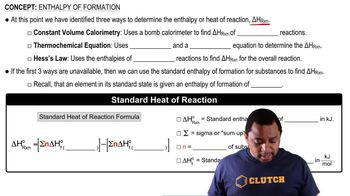
The standard enthalpy of formation (ΔH°f) is the change in enthalpy when one mole of a compound is formed from its elements in their standard states. It is a crucial concept in thermodynamics, as it allows chemists to calculate the energy changes associated with chemical reactions, including combustion, and is typically expressed in kJ/mol. Understanding this concept is vital for determining the energy efficiency and environmental impact of fuels.
Video consigliato:
Percorso guidato
02:34
Enthalpy of Formation

Enthalpy of Combustion (ΔH° combustion)

The enthalpy of combustion (ΔH° combustion) is the heat released when one mole of a substance is completely burned in oxygen under standard conditions. It is an important measure of the energy content of fuels and is typically negative, indicating that the reaction is exothermic. This value is used to assess the energy yield of fuels and is essential for calculating the standard enthalpy of formation of the compound from its combustion products.
Video consigliato:
Percorso guidato
02:24
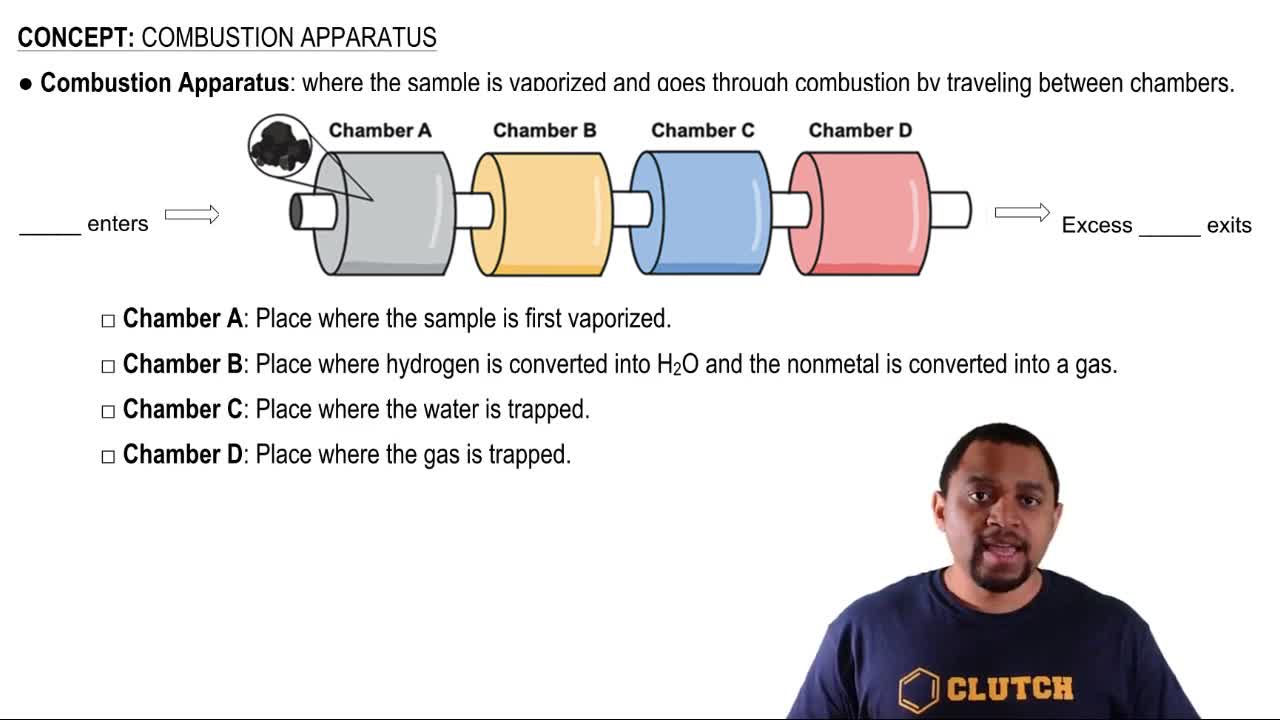
Combustion Apparatus
Pratica correlata
Domanda del libro di testo

Acid spills are often neutralized with sodium carbonate or sodium hydrogen carbonate. For neutralization of acetic acid, the unbalanced equations are

(1) CH3CO2H(l) + Na2CO3(s) → CH3CO2Na(aq) + CO2(g) + H2O(l)

(2) CH3CO2H(l) + NaHCO3(s) → CH3CO2Na(aq) + CO2(g) + H2O(l)

(a) Balance both equations.

689
views
Domanda del libro di testo
9.149 Consider the reaction: 4 CO1g2 2 NO21g2 4 CO21g2 N21g2. Using the following information, determine ΔH° for the reaction at 25 °C. NO1g2 ΔH°f = + 91.3 kJ>mol CO21g2 ΔH°f = - 393.5 kJ>mol 2 NO1g2 + O21g2 S 2 NO21g2 ΔH° = - 116.2 kJ 2 CO1g2 + O21g2 S 2 CO21g2 ΔH° = - 566.0 kJ
408
views
Domanda del libro di testo
Given 400.0 g of hot tea at 80.0 °C, what mass of ice at 0 °C must be added to obtain iced tea at 10.0 °C? The specific heat of the tea is 4.18 J>1g °C2 and ΔHfusion for ice is + 6.01 kJ>mol.
1829
views
Domanda del libro di testo
Imagine that you dissolve 10.0 g of a mixture of NaNO3 and KF in 100.0 g of water and find that the temperature rises by 2.22 °C. Using the following data, calculate the mass of each compound in the original mixture. Assume that the specific heat of the solution is 4.18 J>1 g °C2 NaNO31s2 S NaNO31aq2 ΔH = + 20.4 kJ>mol KF1s2 S KF1aq2 ΔH = - 17.7 kJ>mol
792
views
Domanda del libro di testo
Acid spills are often neutralized with sodium carbonate or sodium hydrogen carbonate. For neutralization of acetic acid, the unbalanced equations are 112 CH3CO2H1l2 + Na2CO31s2 S CH3CO2Na1aq2 + CO21g2 + H2O1l2 122 CH3CO2H1l2 + NaHCO31s2 CH3CO2Na1aq2 + CO21g2 + H2O1l2 (c) How much heat in kilojoules is absorbed or liberated in each reaction? See Appendix B for standard heats of for- mation; ΔH°f = - 726.1 kJ>mol for CH3CO2 Na(aq).
645
views
Domanda del libro di testo

Phosgene, COCl2(g), is a toxic gas used as an agent of warfare in World War I. (b) Using the table of bond dissociation energies (Table 9.3) and the value ΔH°f = 716.7 kJ/mol for C(g), estimate ΔH°f for COCl2(g) at 25 °C. Compare your answer to the actual ΔH°f given in Appendix B, and explain why your calculation is only an estimate.

684
views