Ch.9 - Thermochemistry: Chemical Energy
McMurry - Chemistry 8th Edition
McMurry8th EditionChemistryISBN: 9781292336145Non è quello che usi tu?Cambia libro di testo
Capitolo 9, Problema 137

(d) What is the kinetic energy of an electron traveling at velocity (c)?

Guida verificata passo dopo passo
1
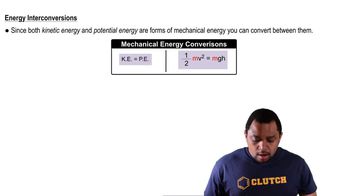
Identify the formula for kinetic energy: \(KE = \frac{1}{2}mv^2\), where \(m\) is the mass of the electron and \(v\) is its velocity.
Determine the mass of an electron, which is approximately \(9.11 \times 10^{-31}\) kg.
Substitute the given velocity \(v = c\) (the speed of light, approximately \(3.00 \times 10^8\) m/s) into the kinetic energy formula.
Calculate the expression \(\frac{1}{2}mv^2\) using the known values for \(m\) and \(v\). Remember to square the velocity.
Ensure the units are consistent and check the calculation for any errors.

Risposta video verificata per un problema simile:

Questa soluzione video è stata consigliata dai nostri tutor come utile per risolvere questo problema.
Durata del video:
1m

Concetti chiave

Ecco i concetti essenziali che devi comprendere per rispondere correttamente alla domanda.

Kinetic Energy

Kinetic energy is the energy possessed by an object due to its motion, calculated using the formula KE = 1/2 mv², where m is the mass and v is the velocity of the object. In the context of particles like electrons, this concept is crucial for understanding how their speed affects their energy levels.
Video consigliato:
Percorso guidato
00:34
Kinetic & Potential Energy

Relativistic Effects

When dealing with particles moving at speeds close to the speed of light (c), relativistic effects become significant. According to Einstein's theory of relativity, the classical kinetic energy formula is modified to account for the increase in mass and energy as an object's velocity approaches c, leading to the equation KE = (γ - 1)mc², where γ is the Lorentz factor.
Video consigliato:
Percorso guidato
02:31
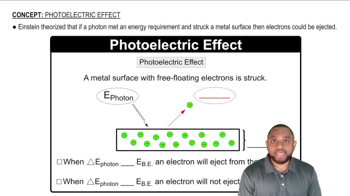
Photoelectric Effect

Mass-Energy Equivalence

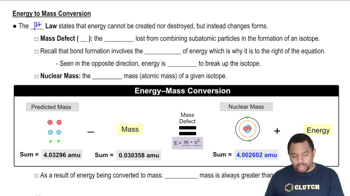
Mass-energy equivalence, expressed by Einstein's equation E=mc², indicates that mass can be converted into energy and vice versa. For high-speed particles like electrons, this principle is essential for understanding how their kinetic energy relates to their mass and the energy they possess when traveling at relativistic speeds.
Video consigliato:
Percorso guidato
04:12
Energy to Mass Conversion