


Ch.9 - Thermochemistry: Chemical Energy
McMurry - Chemistry 8th Edition
McMurry8th EditionChemistryISBN: 9781292336145Non è quello che usi tu?Cambia libro di testo
Capitolo 9, Problema 4

For which of the following reactions are ΔE and ΔH equal? (a) CO2(g) + H2O(l) → H2CO (b) 2 NaHCO3 (s) → Na2CO3(s) + H2O(g) + CO2(g) (c) 2 H2(g) + O2(g) → 2 H2O(g) (d) CH4(g) + 2 O2(g) → CO2(g) + 2 H2O(g)

Guida verificata passo dopo passo
1
First, let's understand what ΔE and ΔH represent. ΔE is the change in internal energy of a system, while ΔH is the change in enthalpy. For ΔE and ΔH to be equal, the system must be at constant pressure and there should be no non-PV work done on or by the system.
Next, we need to identify if any of the reactions involve non-PV work. Non-PV work can include things like electrical work, surface work, etc. In this case, all the reactions are chemical reactions and do not involve any non-PV work.
Then, we need to check if the reactions are at constant pressure. In general chemistry, we usually assume that reactions are carried out at constant pressure unless stated otherwise.
Given these conditions, ΔE and ΔH would be equal for all the reactions provided. However, there is one more factor to consider. If the number of moles of gas changes during the reaction, this can cause a difference between ΔE and ΔH because of the work done by the system due to expansion or contraction.
Finally, we need to identify the reactions where the number of moles of gas does not change. For reaction (a), the number of moles of gas decreases. For reaction (b), the number of moles of gas increases. For reaction (c), the number of moles of gas decreases. For reaction (d), the number of moles of gas remains the same. Therefore, ΔE and ΔH should be equal for reaction (d).

Risposta video verificata per un problema simile:

Questa soluzione video è stata consigliata dai nostri tutor come utile per risolvere questo problema.
Durata del video:
6m

Concetti chiave

Ecco i concetti essenziali che devi comprendere per rispondere correttamente alla domanda.

Internal Energy (ΔE)

Internal energy (ΔE) is the total energy contained within a system, including kinetic and potential energies of the particles. It reflects the energy changes that occur during a chemical reaction, accounting for all forms of energy transfer. In reactions where no work is done on or by the system and no heat is exchanged with the surroundings, ΔE can be directly related to the change in the system's state.
Video consigliato:
Percorso guidato
00:40
Internal Energy

Enthalpy (ΔH)

Enthalpy (ΔH) is a thermodynamic quantity that represents the total heat content of a system at constant pressure. It is used to measure the heat absorbed or released during a chemical reaction. For reactions occurring at constant pressure, ΔH is equal to the heat exchanged, making it a crucial concept for understanding reaction energetics and thermodynamics.
Video consigliato:
Percorso guidato
02:34
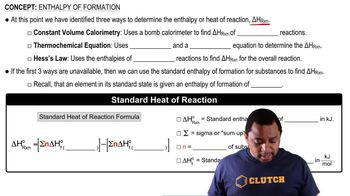
Enthalpy of Formation

Conditions for ΔE = ΔH

ΔE and ΔH are equal under specific conditions, primarily when a reaction occurs at constant pressure and there is no change in the number of moles of gas. This is often the case in reactions where the system does not perform work on the surroundings, such as in reactions involving only liquids and solids, or when the gaseous products and reactants are balanced in terms of moles.
Video consigliato:
Percorso guidato
02:13
Ideal Gas Conditions Example