
Ch.9 - Thermochemistry: Chemical Energy
McMurry - Chemistry 8th Edition
McMurry8th EditionChemistryISBN: 9781292336145Non è quello che usi tu?Cambia libro di testo
Capitolo 9, Problema 99

How is the standard state of an element defined? Why do elements always have ∆H°f = 0?

Guida verificata passo dopo passo
1
The standard state of an element is defined as the most stable physical form of the element at 1 bar of pressure and a specified temperature, usually 25°C (298 K). This includes the physical state (solid, liquid, or gas) and the allotrope, if more than one exists.
In thermodynamics, the standard enthalpy of formation (∆H°f) is the change in enthalpy during the formation of 1 mole of a substance from its constituent elements in their standard states.
For an element in its standard state, the standard enthalpy of formation is defined as zero because there is no change in enthalpy when the element is already in its most stable form under standard conditions.
This convention simplifies calculations in thermochemistry, allowing us to focus on the changes that occur during chemical reactions rather than the absolute values of enthalpy.
Understanding that ∆H°f = 0 for elements in their standard states helps in calculating the enthalpies of formation for compounds, as these values are based on the assumption that all elements are initially in their standard states.

Risposta video verificata per un problema simile:

Questa soluzione video è stata consigliata dai nostri tutor come utile per risolvere questo problema.
Durata del video:
2m

Concetti chiave

Ecco i concetti essenziali che devi comprendere per rispondere correttamente alla domanda.

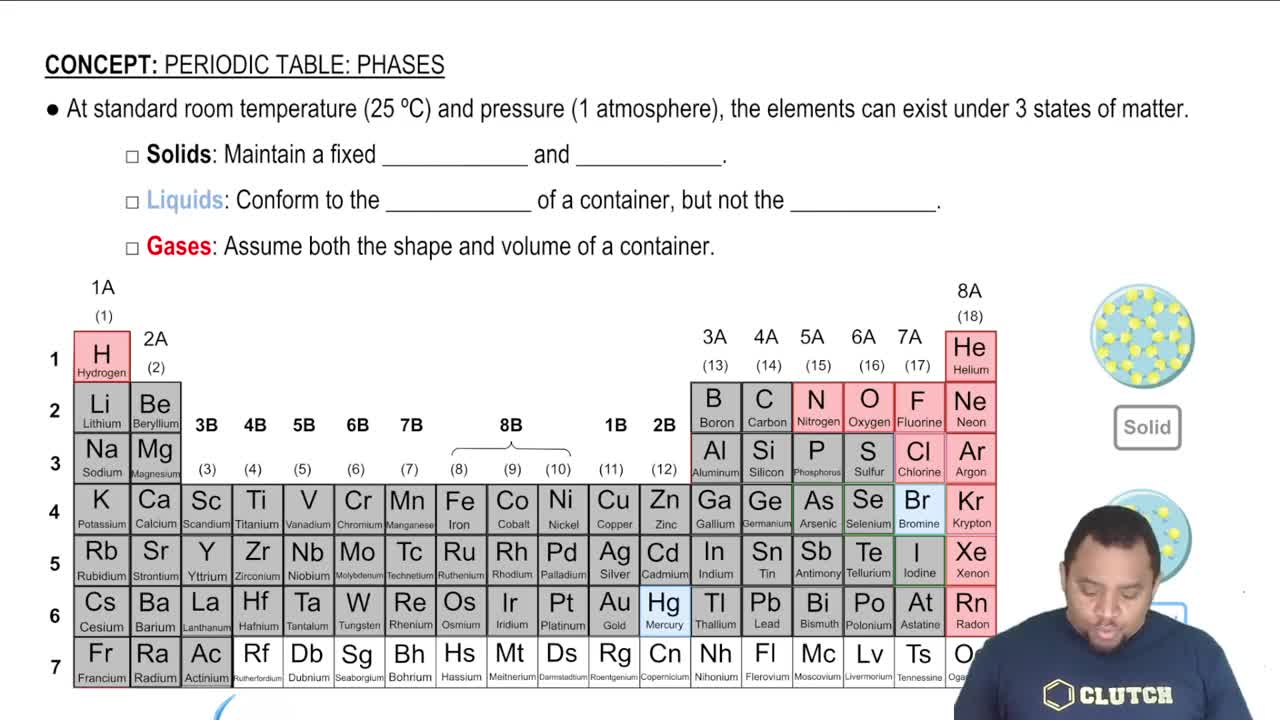
Standard State of an Element

The standard state of an element refers to its most stable physical form at a specified temperature and pressure, typically 1 bar (or 1 atm) and 25°C. For example, the standard state of oxygen is O2 gas, while that of carbon is graphite. This definition is crucial for thermodynamic calculations and comparisons.
Video consigliato:
Percorso guidato
03:25
Element States of Matter

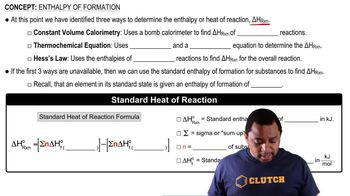
Enthalpy of Formation (∆H°f)

The enthalpy of formation (∆H°f) is the change in enthalpy when one mole of a compound is formed from its elements in their standard states. By convention, the ∆H°f of any element in its standard state is defined as zero. This allows for a consistent reference point when calculating the enthalpy changes of reactions involving compounds.
Video consigliato:
Percorso guidato
02:34
Enthalpy of Formation

Thermodynamic Convention

Thermodynamic conventions, such as defining the standard enthalpy of formation as zero for elements, provide a systematic approach to thermodynamic calculations. This convention simplifies the understanding of energy changes in chemical reactions and allows chemists to easily compare the stability and reactivity of different substances based on their enthalpy values.
Video consigliato:
Percorso guidato
01:18
First Law of Thermodynamics