
Ch.9 - Thermochemistry: Chemical Energy
McMurry - Chemistry 8th Edition
McMurry8th EditionChemistryISBN: 9781292336145Non è quello che usi tu?Cambia libro di testo
Capitolo 9, Problema 7

How much heat is required to raise a 50.0 g piece of iron from 25 °C to its melting point of 1538 °C? The specific heat capacity for iron is 0.451 J/g•°C. (a) 34.1 kJ (b) 168 kJ (c) 12.1 kJ (d) 6.78 kJ

Guida verificata passo dopo passo
1
Identify the given values: mass of iron (m) = 50.0 g, initial temperature (T_initial) = 25 °C, final temperature (T_final) = 1538 °C, and specific heat capacity of iron (c) = 0.451 J/g•°C.
Understand the formula for heat transfer, which is Q = m * c * ΔT, where Q is the heat required, m is the mass, c is the specific heat capacity, and ΔT is the change in temperature.
Calculate the change in temperature (ΔT) by subtracting the initial temperature from the final temperature: ΔT = T_final - T_initial.
Substitute the values into the heat transfer formula: Q = 50.0 g * 0.451 J/g•°C * (1538 °C - 25 °C).
Convert the result from joules to kilojoules by dividing by 1000, as 1 kJ = 1000 J.

Risposta video verificata per un problema simile:

Questa soluzione video è stata consigliata dai nostri tutor come utile per risolvere questo problema.
Durata del video:
2m

Concetti chiave

Ecco i concetti essenziali che devi comprendere per rispondere correttamente alla domanda.

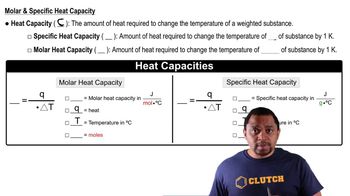
Specific Heat Capacity

Specific heat capacity is the amount of heat required to raise the temperature of one gram of a substance by one degree Celsius. It is a material-specific property that indicates how much energy is needed to change the temperature of a substance, which is crucial for calculating heat transfer in thermal processes.
Video consigliato:

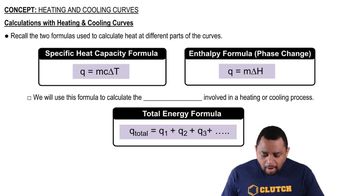
Heat Transfer Calculation

The heat transfer (q) required to change the temperature of a substance can be calculated using the formula q = m × c × ΔT, where m is the mass, c is the specific heat capacity, and ΔT is the change in temperature. This formula allows us to quantify the energy needed for temperature changes in various materials.
Video consigliato:
Percorso guidato
01:05
Calculations with Heating and Cooling Curves

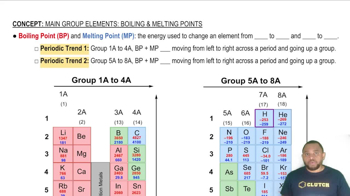
Phase Change and Melting Point

The melting point is the temperature at which a solid becomes a liquid. In this context, understanding the melting point of iron (1538 °C) is essential, as it indicates the temperature to which the iron must be heated. The energy required to reach this temperature from an initial state is calculated using the specific heat capacity.
Video consigliato:
Percorso guidato
04:29
Boiling Point and Melting Point
Pratica correlata
Domanda del libro di testo

Several processes are given in the table and labeled as endo- thermic or exothermic and given a sign for ∆H°. Which process is labeled with the correct sign of ∆H° and correct classification as endothermic or exothermic? (LO 9.8) Process (c) Water freezes into ice in the freezer.

288
views
Domanda del libro di testo

Several processes are given in the table and labeled as endo- thermic or exothermic and given a sign for ∆H°. Which process is labeled with the correct sign of ∆H° and correct classification as endothermic or exothermic? (LO 9.8) Process (d) Rubbing alcohol evaporates from your skin.

263
views
Domanda del libro di testo

Several processes are given in the table and labeled as endo- thermic or exothermic and given a sign for ∆H°. Which process is labeled with the correct sign of ∆H° and correct classification as endothermic or exothermic? (LO 9.8) Process (b) Methane, the main component of natural gas, is burned to produce a flame on a stovetop.

273
views
Domanda del libro di testo
Calculate the enthalpy change for the reaction C(s) + 2 H2(g) → CH4(g) ΔH = ? Given the enthalpy values for the following reactions CH4(g) + 2 O2(g) → CO2(g) + 2 H2O(l) ΔH = −890.4 kJ C(s) + O2(g) → CO2(g) ΔH = −393.5 kJ H2(g) + 1/2 O2(g) → H2O (g) ΔH = −285.8 kJ (a) −1569.7 kJ (b) +211.1 kJ (c) −1855.5 kJ (d) −74.7 kJ
4125
views
Domanda del libro di testo
A 25.0 g piece of granite at 100.0°C was added to 100.0 g of water of 25.0°C, and the temperature rose to 28.4°C. What is the specific heat capacity of the granite? (The specific heat capacity for water is 4.18 J/(g•°C).) (LO 9.10) (a) 0.563 J/(g•°C) (b) 1.53 J/(g•°C) (c) 0.992 J/(g•°C) (d) 0.794 J/(g•°C)
1328
views
Domanda del libro di testo

When 12.5 g of NH4NO3 is dissolved in 150.0 g of water of 25.0 °C in a coffee cup calorimeter, the final temperature of the solution of 19.7 °C. Assume that the specific heat of the solution is the same as that of water, 4.18 J/(g•°C). What is the ΔH per mol of NH4NO3? (LO 9.10) NH4NO3 (s) → NH4+ (aq) + NO3−(aq) ΔH = ? (a) +3.60 kJ (b) +23.0 kJ (c) +21.3 kJ (d) −3.60 kJ

2942
views