
Ch.9 - Thermochemistry: Chemical Energy
McMurry - Chemistry 8th Edition
McMurry8th EditionChemistryISBN: 9781292336145Non è quello che usi tu?Cambia libro di testo
Capitolo 9, Problema 143e

Methanol (CH3OH) is made industrially in two steps from CO and H2. It is so cheap to make that it is being considered for use as a precursor to hydrocarbon fuels, such as methane (CH4):
Step 1. CO(g) + 2 H2(g) S CH3OH(l) ΔS° = - 332 J/K
Step 2. CH3OH(l) → CH4(g) + 1/2 O2(g) ΔS° = 162 J/K
(e) In what temperature range is step 1 spontaneous?

Guida verificata passo dopo passo
1
Identify the condition for spontaneity: A reaction is spontaneous when the change in Gibbs free energy (\( \Delta G \)) is negative. The relationship is given by \( \Delta G = \Delta H - T \Delta S \), where \( \Delta H \) is the change in enthalpy, \( T \) is the temperature in Kelvin, and \( \Delta S \) is the change in entropy.
For step 1, we are given \( \Delta S^\circ = -332 \text{ J/K} \). We need to find the temperature range where the reaction is spontaneous, i.e., where \( \Delta G < 0 \).
Rearrange the equation for \( \Delta G \) to find the temperature: \( T < \frac{\Delta H}{\Delta S} \). Since \( \Delta S \) is negative, \( \Delta H \) must also be negative for the reaction to be spontaneous at some temperature.
Assume \( \Delta H \) is known or can be estimated from standard enthalpies of formation. Substitute \( \Delta H \) and \( \Delta S \) into the inequality \( T < \frac{\Delta H}{\Delta S} \) to solve for the temperature range.
Interpret the result: The temperature range obtained will indicate the maximum temperature below which the reaction is spontaneous.

Risposta video verificata per un problema simile:

Questa soluzione video è stata consigliata dai nostri tutor come utile per risolvere questo problema.
Durata del video:
4m

Concetti chiave

Ecco i concetti essenziali che devi comprendere per rispondere correttamente alla domanda.

Gibbs Free Energy

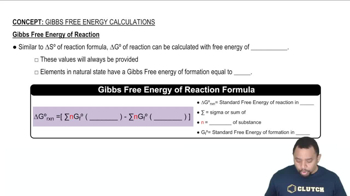
Gibbs Free Energy (G) is a thermodynamic potential that helps predict the spontaneity of a process at constant temperature and pressure. A reaction is spontaneous if the change in Gibbs Free Energy (ΔG) is negative. The relationship between ΔG, enthalpy (ΔH), and entropy (ΔS) is given by the equation ΔG = ΔH - TΔS, where T is the temperature in Kelvin. Understanding this concept is crucial for determining the conditions under which a reaction, such as the formation of methanol, will occur spontaneously.
Video consigliato:
Percorso guidato
01:51
Gibbs Free Energy of Reactions

Entropy (ΔS)

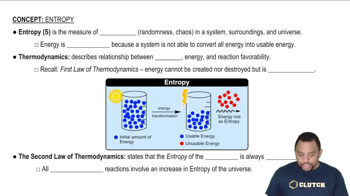
Entropy (ΔS) is a measure of the disorder or randomness in a system. In the context of chemical reactions, a negative ΔS indicates that the reaction leads to a decrease in disorder, while a positive ΔS suggests an increase in disorder. The entropy changes for the steps in the methanol production process are essential for evaluating the spontaneity of the reactions. A reaction with a significant negative ΔS may require lower temperatures to remain spontaneous, as indicated by the Gibbs Free Energy equation.
Video consigliato:
Percorso guidato
02:46
Entropy in Thermodynamics

Temperature and Spontaneity

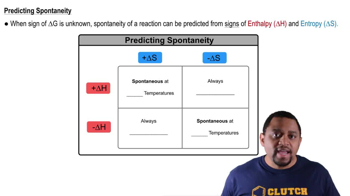
Temperature plays a critical role in determining the spontaneity of a reaction, particularly when considering the entropy change. According to the Gibbs Free Energy equation, as temperature increases, the TΔS term becomes more significant. For a reaction to be spontaneous, the negative contribution from ΔH must outweigh the positive contribution from TΔS. Therefore, analyzing the temperature range where the entropy changes are favorable is essential for understanding when step 1 of methanol production will be spontaneous.
Video consigliato:
Percorso guidato
01:17
Spontaneity and Temperature
Pratica correlata
Domanda del libro di testo

Methanol (CH3OH) is made industrially in two steps from CO and H2. It is so cheap to make that it is being considered for use as a precursor to hydrocarbon fuels, such as methane (CH4):

Step 1. CO(g) + 2 H2(g) → CH3OH(l) ΔS° = –332 J/K

Step 2. CH3OH(l) → CH4(g) + 1/2 O2(g) ΔS° = 162 J/K

(a) Calculate ΔH° in kilojoules for step 1.

464
views
Domanda del libro di testo

Methanol (CH3OH) is made industrially in two steps from CO and H2. It is so cheap to make that it is being considered for use as a precursor to hydrocarbon fuels, such as methane (CH4):

Step 1. CO(g) + 2 H2(g) → CH3OH(l) ΔS° = –332 J/K

Step 2. CH3OH(l) → CH4(g) + 1/2 O2(g) ΔS° = 162 J/K

(f) Calculate ΔH° for step 2.

369
views
Domanda del libro di testo
Metallic mercury is obtained by heating the mineral cinnabar (HgS) in air: HgS1s2 + O21g2 S Hg1l2 + SO21g2 (a) Use the data in Appendix B to calculate ΔH° in kilojoules for the reaction.
720
views
Domanda del libro di testo
Ethyl chloride 1C2H5Cl2, a substance used as a topical anes-thetic, is prepared by reaction of ethylene with hydrogen chloride: C2H41g2 + HCl1g2 ¡ C2H5Cl1g2 ΔH° = - 72.3 kJ How much PV work is done in kilojoules, and what is the value of ΔE in kilojoules if 89.5 g of ethylene and 125 g of HCl are allowed to react at atmospheric pressure and the volume change is - 71.5 L?
904
views
Domanda del libro di testo
We said in Section 9.1 that the potential energy of water at the top of a dam or waterfall is converted into heat when the water dashes against rocks at the bottom. The potential energy of the water at the top is equal to EP = mgh, where m is the mass of the water, g is the acceleration of the falling water due to gravity 1g = 9.81 m>s22, and h is the height of the water. Assuming that all the energy is converted to heat, calculate the temperature rise of the water in degrees Celsius after falling over California's Yosemite Falls, a distance of 739 m. The specific heat of water is 4.18 J/(g·K).
2019
views