

Ch.9 - Thermochemistry: Chemical Energy
McMurry - Chemistry 8th Edition
McMurry8th EditionChemistryISBN: 9781292336145Non è quello che usi tu?Cambia libro di testo
Capitolo 9, Problema 104

Sulfuric acid (H2SO4), the most widely produced chemical in the world, is amde yb a two-step oxidaiton of sulfur to sulfur trioxide, SO3, followed by reaciton with water. Calculate ΔH°f for SO3 in kJ/mol, given the following data: S(s) + O2(g) → SO2(g) ΔH° = -296.8 kJ SO2(g) + 1/2 O2(g) → SO3(g) ΔH° = -98.9 kJ

Guida verificata passo dopo passo
1
Identify the overall reaction for the formation of SO3 from its elements in their standard states. The overall reaction is: S(s) + 3/2 O2(g) → SO3(g).
Break down the overall reaction into the given steps and write down the enthalpy changes for each step. Step 1: S(s) + O2(g) → SO2(g), ΔH° = -296.8 kJ. Step 2: SO2(g) + 1/2 O2(g) → SO3(g), ΔH° = -98.9 kJ.
Add the enthalpy changes from the two steps to find the overall enthalpy change for the formation of SO3. Use the equation: ΔH°(overall) = ΔH°(step 1) + ΔH°(step 2).
Substitute the given values into the equation from step 3 to calculate the overall ΔH° for the formation of SO3.
The calculated ΔH° for the formation of SO3 from sulfur and oxygen is the ΔH°f (standard enthalpy of formation) of SO3.

Risposta video verificata per un problema simile:

Questa soluzione video è stata consigliata dai nostri tutor come utile per risolvere questo problema.
Durata del video:
3m

Concetti chiave

Ecco i concetti essenziali che devi comprendere per rispondere correttamente alla domanda.

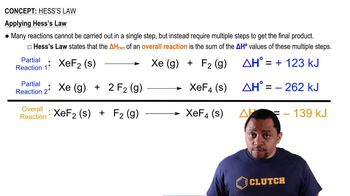
Hess's Law

Hess's Law states that the total enthalpy change for a chemical reaction is the sum of the enthalpy changes for the individual steps of the reaction, regardless of the pathway taken. This principle allows us to calculate the enthalpy change for a reaction by using known enthalpy changes of related reactions, making it essential for determining ΔH°f values.
Video consigliato:

Standard Enthalpy of Formation (ΔH°f)

The standard enthalpy of formation (ΔH°f) is defined as the change in enthalpy when one mole of a compound is formed from its elements in their standard states. It is a crucial concept in thermodynamics, as it provides a reference point for calculating the enthalpy changes of various reactions, including the formation of sulfur trioxide (SO3) in this case.
Video consigliato:
Percorso guidato
02:34
Enthalpy of Formation

Enthalpy Change (ΔH)

Enthalpy change (ΔH) refers to the heat content change of a system at constant pressure during a chemical reaction. It can be either exothermic (releasing heat, ΔH < 0) or endothermic (absorbing heat, ΔH > 0). Understanding how to manipulate ΔH values from given reactions is essential for calculating the enthalpy of formation for compounds like SO3.
Video consigliato:
Percorso guidato
02:34
Enthalpy of Formation