Ch.9 - Thermochemistry: Chemical Energy
McMurry - Chemistry 8th Edition
McMurry8th EditionChemistryISBN: 9781292336145Non è quello che usi tu?Cambia libro di testo
Capitolo 9, Problema 62

The enthalpy change for the reaction of 50.0 mL of ethylene with 50.0 mL of H2 at 1.5 atm pressure (Problem 9.51) is ∆H = -0.31 kJ. What is the value of ∆E?

Guida verificata passo dopo passo
1
Identify the relationship between enthalpy change (\( \Delta H \)) and internal energy change (\( \Delta E \)) using the equation: \( \Delta E = \Delta H - \Delta nRT \).
Determine \( \Delta n \), the change in moles of gas, by analyzing the balanced chemical equation for the reaction of ethylene (C2H4) with hydrogen (H2) to form ethane (C2H6).
Calculate \( \Delta n \) by subtracting the moles of gaseous products from the moles of gaseous reactants.
Use the ideal gas constant \( R = 8.314 \text{ J/mol·K} \) and convert it to kJ by dividing by 1000, and use the temperature in Kelvin (assume standard conditions if not specified, 298 K).
Substitute the values of \( \Delta H \), \( \Delta n \), \( R \), and \( T \) into the equation \( \Delta E = \Delta H - \Delta nRT \) to find \( \Delta E \).

Risposta video verificata per un problema simile:

Questa soluzione video è stata consigliata dai nostri tutor come utile per risolvere questo problema.
Durata del video:
2m

Concetti chiave

Ecco i concetti essenziali che devi comprendere per rispondere correttamente alla domanda.

Enthalpy (∆H)

Enthalpy is a thermodynamic quantity that represents the total heat content of a system. It is defined as the internal energy of the system plus the product of its pressure and volume (H = U + PV). In chemical reactions, the change in enthalpy (∆H) indicates whether the reaction is exothermic (releases heat, ∆H < 0) or endothermic (absorbs heat, ∆H > 0).
Video consigliato:
Percorso guidato
02:34
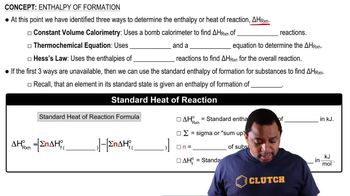
Enthalpy of Formation

Internal Energy (∆E)

Internal energy is the total energy contained within a system, encompassing kinetic and potential energies of the particles. The change in internal energy (∆E) during a reaction can be calculated using the first law of thermodynamics, which states that the change in internal energy is equal to the heat added to the system minus the work done by the system (∆E = q - W).
Video consigliato:
Percorso guidato
00:40
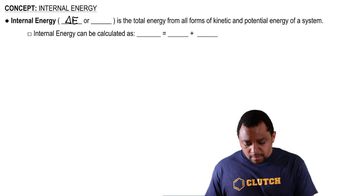
Internal Energy

Relationship between ∆H and ∆E

The relationship between enthalpy change (∆H) and internal energy change (∆E) is given by the equation ∆H = ∆E + P∆V, where P is the pressure and ∆V is the change in volume. For reactions occurring at constant pressure, if the volume change is negligible, ∆H can be approximated as equal to ∆E. However, if there is a significant volume change, this relationship must be considered to accurately calculate ∆E.
Video consigliato:
Percorso guidato
02:43
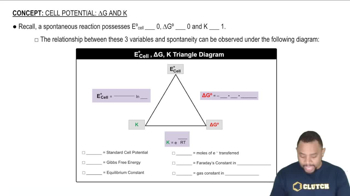
Relationship between ∆E°, ∆G°, and K