Ch.9 - Thermochemistry: Chemical Energy
McMurry - Chemistry 8th Edition
McMurry8th EditionChemistryISBN: 9781292336145Non è quello che usi tu?Cambia libro di testo
Capitolo 9, Problema 40c

The following reaction is exothermic: (c) Is the reaction likely to be spontaneous at lower temperatures only, at higher temperatures only, or at all temperatures?

Guida verificata passo dopo passo
1
insert step 1> Understand that an exothermic reaction releases heat, meaning the change in enthalpy (\( \Delta H \)) is negative.
insert step 2> Recall that the spontaneity of a reaction is determined by the Gibbs free energy change (\( \Delta G \)), which is given by the equation \( \Delta G = \Delta H - T\Delta S \), where \( T \) is the temperature and \( \Delta S \) is the change in entropy.
insert step 3> Consider that for a reaction to be spontaneous, \( \Delta G \) must be negative.
insert step 4> Analyze the equation \( \Delta G = \Delta H - T\Delta S \): since \( \Delta H \) is negative for an exothermic reaction, the sign of \( \Delta G \) will depend on the sign and magnitude of \( \Delta S \) and the temperature \( T \).
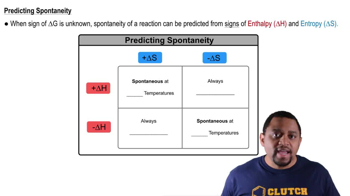
insert step 5> Conclude that if \( \Delta S \) is positive, the reaction is more likely to be spontaneous at all temperatures, but if \( \Delta S \) is negative, the reaction is more likely to be spontaneous at lower temperatures.

Risposta video verificata per un problema simile:

Questa soluzione video è stata consigliata dai nostri tutor come utile per risolvere questo problema.
Durata del video:
2m

Concetti chiave

Ecco i concetti essenziali che devi comprendere per rispondere correttamente alla domanda.

Exothermic Reactions

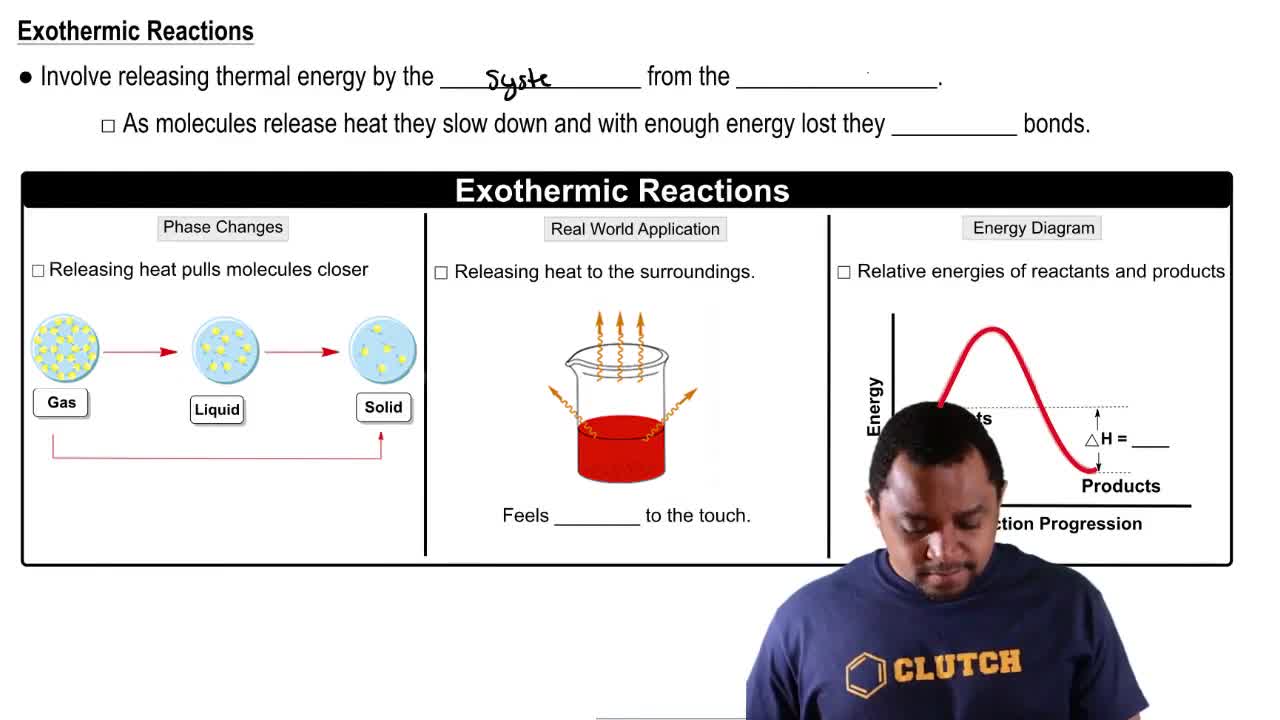
Exothermic reactions are chemical processes that release energy, usually in the form of heat, to the surroundings. This release of energy often results in an increase in temperature of the surrounding environment. Understanding whether a reaction is exothermic helps predict its behavior under different temperature conditions, particularly in relation to spontaneity.
Video consigliato:
Percorso guidato
02:38
Endothermic & Exothermic Reactions

Spontaneity of Reactions

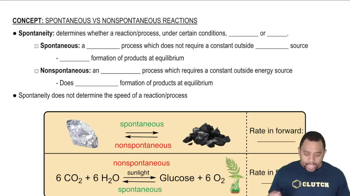
A reaction is considered spontaneous if it occurs without the need for continuous external energy input. The spontaneity of a reaction is determined by the change in Gibbs free energy (ΔG); if ΔG is negative, the reaction is spontaneous. Factors such as enthalpy, entropy, and temperature play crucial roles in determining whether a reaction will be spontaneous under specific conditions.
Video consigliato:
Percorso guidato
04:20
Spontaneity of Processes

Temperature's Effect on Spontaneity

Temperature significantly influences the spontaneity of reactions, particularly those involving changes in entropy. For exothermic reactions, lower temperatures generally favor spontaneity due to the negative ΔH (enthalpy change). However, at higher temperatures, the entropy change (ΔS) can also affect spontaneity, making it essential to consider both enthalpy and entropy when evaluating reaction behavior across different temperature ranges.
Video consigliato:
Percorso guidato
01:17
Spontaneity and Temperature