


Ch.9 - Thermochemistry: Chemical Energy
McMurry - Chemistry 8th Edition
McMurry8th EditionChemistryISBN: 9781292336145Non è quello che usi tu?Cambia libro di testo
Capitolo 9, Problema 93

The following steps occur in the reaction of ethyl alcohol (CH3CH2OH) wiht oxygen to yield acetic acid (CH3CO2H). Show that equations 1 and 2 sum to give the net equation and calculate ΔH° for the net equation. (1) CH3CH2OH(l) + 1/2 O2(g) → CH3CHO (g) + H2O(l) ΔH° = -174.2 kJ (2) CH3CHO(g) + 1/2 O2(g) → CH3CO2H(l) ΔH° = -318.4 kJ (Net) CH3CH2OH(l) + O2(g) → CH3CO2H(l) + H2O(l) ΔH° = ?

Guida verificata passo dopo passo
1
Write down the given equations and their respective enthalpy changes (ΔH°). Equation 1: CH3CH2OH(l) + 1/2 O2(g) → CH3CHO(g) + H2O(l), ΔH° = -174.2 kJ. Equation 2: CH3CHO(g) + 1/2 O2(g) → CH3CO2H(l), ΔH° = -318.4 kJ.
Add the two equations together. When you do this, ensure that the reactants and products that appear on both sides of the equations cancel each other out. In this case, CH3CHO(g) appears as a product in Equation 1 and as a reactant in Equation 2.
Verify that the resulting equation matches the net equation provided: CH3CH2OH(l) + O2(g) → CH3CO2H(l) + H2O(l).
Sum the ΔH° values from Equation 1 and Equation 2 to find the ΔH° for the net equation. This is done by adding -174.2 kJ and -318.4 kJ.
The resulting sum of ΔH° values will give you the ΔH° for the net reaction, which represents the total enthalpy change for the conversion of ethyl alcohol to acetic acid in the presence of oxygen.

Risposta video verificata per un problema simile:

Questa soluzione video è stata consigliata dai nostri tutor come utile per risolvere questo problema.
Durata del video:
3m

Concetti chiave

Ecco i concetti essenziali che devi comprendere per rispondere correttamente alla domanda.

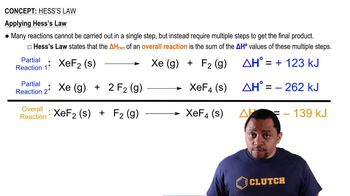
Hess's Law

Hess's Law states that the total enthalpy change for a chemical reaction is the sum of the enthalpy changes for the individual steps of the reaction, regardless of the pathway taken. This principle allows us to calculate the enthalpy change of a net reaction by adding the enthalpy changes of the intermediate reactions, as long as the initial and final states are the same.
Video consigliato:

Enthalpy Change (ΔH°)

Enthalpy change (ΔH°) is a measure of the heat content of a system at constant pressure. It indicates whether a reaction is exothermic (releases heat, ΔH° < 0) or endothermic (absorbs heat, ΔH° > 0). In this context, calculating ΔH° for the net reaction involves summing the ΔH° values of the individual steps to find the overall energy change.
Video consigliato:
Percorso guidato
02:34
Enthalpy of Formation

Balancing Chemical Equations

Balancing chemical equations is essential to ensure that the number of atoms of each element is conserved in a reaction. In this case, the net equation must reflect the stoichiometry of the reactants and products accurately. This involves adjusting coefficients to balance the equation, which is crucial for correctly calculating the enthalpy change and understanding the reaction's dynamics.
Video consigliato:
Percorso guidato
01:32
Balancing Chemical Equations
Pratica correlata
Domanda del libro di testo
The industrial degreasing solvent methylene chloride, CH2Cl2, is prepared from methane by reaction with chlorine: CH4(g) + 2 Cl2(g) → CH2Cl2(g) + 2 HCl(g) Use the following data to calcualte ΔH° in kilojoules for the reaction: CH4(g) + Cl2(g) → CH3Cl(g) + HCl(g) ΔH° = -98.3 kJ CH3Cl(g) + Cl2(g) → CH2Cl2(g) + HCl(g) ΔH° = -104 kJ
710
views
Domanda del libro di testo
Hess's law can be used to calculate reaction enthalpies for hypothetical processes that can't be carried out in the labo- ratory. Set up a Hess's law cycle that will let you calculate ∆H° for the conversion of methane to ethylene: 2 CH4(g) → C2H4(g) + 2 H2(g) You can use the following information: 2 C2H6(g) + 7 O2(g) → 4 CO2(g) + 6 H2O(l) ∆H° = -3120.8 kJ CH4(g) + 2 O2(g) → CO2(g) + 2 H2O(l) ∆H° = -890.3 kJ C2H4(g) + H2(g) → C2H6(g) ∆H° = -136.3 kJ H2O(l) ∆H°f = -285.8 kJ/mol
1018
views
Domanda del libro di testo
A 110.0 g piece of molybdenum metal is heated to 100.0 °C and placed in a calorimeter that contains 150.0 g of water at 24.6 °C. The system reaches equilibirum at a final temeprature of 28.0 °C. Calcualte the specific heat of molybdenum metal in J/g·°C. The specific heat of water is 4.18 J/g·°C
985
views
Domanda del libro di testo
Find ∆H° in kilojoules for the reaciton of nitric oxide with oxygen, 2 NO(g) + O2(g) → N2O4(g), given the following data: N2O4(g) → 2 NO2(g) ∆H° = 55.3 kJ NO(g) + 1/2 O2(g) → NO2(g) ∆H° = -58.1 kJ
970
views
Domanda del libro di testo
What is Hess's law, and why does it 'work'?
598
views
Domanda del libro di testo
Citric acid has three dissociable hydrogens. When 5.00 mL of 0.64 M citric acid and 45.00 mL of 0.77 M NaOH are mixed at an initial temperature of 26.0 °C, the temperature rises to 27.9 °C as the citric acid is neutralized. The combined mixture ahs a mass of 51.6 g and a specific heat of 4.0 J/(g·°C). Assuming that no heat is transferred to the surroundings, cal- culate the enthalpy change for the reaction of 1.00 mol of cit- ric acid in kJ. Is the reaction exothermic or endothermic?
630
views