Ch.9 - Thermochemistry: Chemical Energy
McMurry - Chemistry 8th Edition
McMurry8th EditionChemistryISBN: 9781292336145Non è quello che usi tu?Cambia libro di testo
Capitolo 9, Problema 116c

Use the data in Appendix B to find standard enthalpies of reaction in kilojoules for the following processes: (c) Fe2O3 (s) + 3 CO (g) → Fe(s) + 3 CO2(g)

Guida verificata passo dopo passo
1
Identify the reactants and products in the given chemical reaction. For this reaction, the reactants are Fe2O3 (s) and CO (g), and the products are Fe (s) and CO2 (g).
Look up the standard enthalpy of formation (\(\Delta H_f^\circ\)) for each reactant and product in Appendix B. The values you need are for Fe2O3 (s), CO (g), Fe (s), and CO2 (g).
Write down the standard enthalpy of formation for each substance. Make sure to note the physical state (solid, liquid, gas) as it is crucial for accurate values.
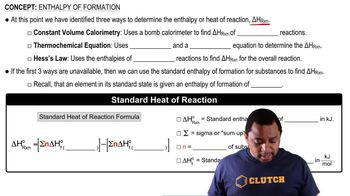
Apply Hess's Law to calculate the standard enthalpy of reaction (\(\Delta H_{rxn}^\circ\)). Use the formula: \(\Delta H_{rxn}^\circ = \sum (\Delta H_f^\circ \text{ of products}) - \sum (\Delta H_f^\circ \text{ of reactants})\).
Substitute the standard enthalpies of formation into the equation and calculate the sum for the products and the reactants separately. Then, find the difference between these sums to get the standard enthalpy of reaction.

Risposta video verificata per un problema simile:

Questa soluzione video è stata consigliata dai nostri tutor come utile per risolvere questo problema.
Durata del video:
4m

Concetti chiave

Ecco i concetti essenziali che devi comprendere per rispondere correttamente alla domanda.

Standard Enthalpy of Reaction

The standard enthalpy of reaction (ΔH°) is the change in enthalpy when reactants are converted to products under standard conditions (1 atm pressure and 25°C). It is a crucial concept in thermodynamics, allowing chemists to predict the heat absorbed or released during a chemical reaction. This value can be calculated using Hess's law or from standard enthalpies of formation.
Video consigliato:
Percorso guidato
02:34
Enthalpy of Formation

Hess's Law

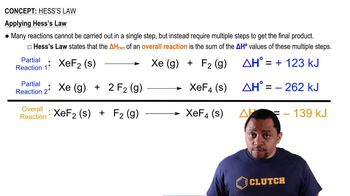
Hess's Law states that the total enthalpy change for a reaction is the sum of the enthalpy changes for individual steps, regardless of the pathway taken. This principle allows for the calculation of enthalpy changes for reactions that are difficult to measure directly by using known enthalpy changes of related reactions. It emphasizes the state function nature of enthalpy.
Video consigliato:

Enthalpy of Formation

The enthalpy of formation (ΔHf°) is the change in enthalpy when one mole of a compound is formed from its elements in their standard states. These values are tabulated for many substances and are essential for calculating the standard enthalpy of reaction using the formula: ΔH° = ΣΔHf°(products) - ΣΔHf°(reactants). Understanding this concept is vital for thermodynamic calculations in chemistry.
Video consigliato:
Percorso guidato
02:34
Enthalpy of Formation