
Ch.9 - Thermochemistry: Chemical Energy
McMurry - Chemistry 8th Edition
McMurry8th EditionChemistryISBN: 9781292336145Non è quello che usi tu?Cambia libro di testo
Capitolo 9, Problema 88

When 1.50 g of magnesium metal is allowed to react with 200 mL of 6.00 M aqueous HCl, the temperature rises from 25.0 °C to 42.9 °C. Calculate ΔH in kilojoules for the reaction, assumign that the heat capacity of the calorimeter is 776 J/°C, that the specific heat of the final soltuion is the same as that of water [4.18 J(g·°C)] and that the density of the solution is 1.00 g/mL

Guida verificata passo dopo passo
1
Step 1: Calculate the total heat absorbed by the calorimeter using the formula: \( q_{calorimeter} = C_{cal} \times \Delta T \), where \( C_{cal} \) is the heat capacity of the calorimeter and \( \Delta T \) is the change in temperature.
Step 2: Calculate the mass of the solution. Since the density of the solution is given as 1.00 g/mL, multiply the volume of the solution (200 mL) by the density to find the mass in grams.
Step 3: Calculate the heat absorbed by the solution using the formula: \( q_{solution} = m_{solution} \times c_{solution} \times \Delta T \), where \( m_{solution} \) is the mass of the solution, \( c_{solution} \) is the specific heat capacity of the solution, and \( \Delta T \) is the change in temperature.
Step 4: Calculate the total heat change for the reaction by adding the heat absorbed by the calorimeter and the heat absorbed by the solution: \( q_{total} = q_{calorimeter} + q_{solution} \).
Step 5: Convert the total heat change from joules to kilojoules by dividing by 1000, and then determine the enthalpy change (\( \Delta H \)) for the reaction. Since the reaction is exothermic, \( \Delta H \) will be negative.

Risposta video verificata per un problema simile:

Questa soluzione video è stata consigliata dai nostri tutor come utile per risolvere questo problema.
Durata del video:
8m

Concetti chiave

Ecco i concetti essenziali che devi comprendere per rispondere correttamente alla domanda.

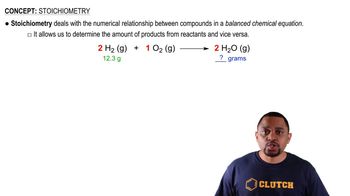
Stoichiometry

Stoichiometry is the calculation of reactants and products in chemical reactions. It involves using balanced chemical equations to determine the relationships between the amounts of substances consumed and produced. In this question, stoichiometry is essential to relate the mass of magnesium reacting to the moles of HCl and the heat produced during the reaction.
Video consigliato:
Percorso guidato
01:16
Stoichiometry Concept

Calorimetry

Calorimetry is the science of measuring the heat of chemical reactions or physical changes. In this scenario, the temperature change of the solution is measured to calculate the heat absorbed or released during the reaction. The heat capacity of the calorimeter and the specific heat of the solution are crucial for determining the total heat change, which is necessary for calculating ΔH.
Video consigliato:
Percorso guidato
00:50
Constant-Volume Calorimetry

Enthalpy Change (ΔH)

Enthalpy change (ΔH) represents the heat content change of a system at constant pressure during a reaction. It can be calculated using the formula ΔH = q/n, where q is the heat absorbed or released and n is the number of moles of the limiting reactant. Understanding ΔH is vital for evaluating the energy changes associated with the reaction between magnesium and hydrochloric acid.
Video consigliato:
Percorso guidato
02:34
Enthalpy of Formation
Pratica correlata
Domanda del libro di testo
Instant hot packs contain a solid and a pouch of water. When the pack is squeezed, the pouch breaks and the solid dis- solves, increasing the temperature because of the exothermic reaciton. The following reaction is used to make a hot pack: H2O LiCl1s2 ¡ Li 1aq2 + Cl 1aq2 ∆H = -36.9 kJ. What is the final temperature in a squeezed hot pack that contains 25.0 g of LiCl dissolved# in 125 mL of water? Assume a specific heat of 4.18 J>1g °C2 for the solution, an initial temperature of 25.0 °C, and no heat transfer between the hot pack and the environment.
1212
views
Domanda del libro di testo
Instant cold packs used to treat athletic injuries contain solid NH4NO3 and a pouch of water. When the pack is squeezed, the pouch breaks and the solid dissolves, lowering the tem-perature because of the endothermic reaction NH4NO31s2 ¡ NH4NO31aq2 ∆H = +25.7 kJ What is the final temperature in a squeezed cold pack that contains 50.0 g of NH4NO3 dissolved in 125 mL of water? Assume a specific heat of 4.18 J/(g C) for the solution, an initial temperature of 25.0 °C, and no heat transfer between the cold pack and the environment.
1652
views
Domanda del libro di testo
When 0.187 g of benzene, C6H6, is burned in a bomb calorimeter the temperature rises by 3.45 °C. If the heat capacity of the calorimeter is 2.46 kJ>°C, calculate the combustion energy 1∆E2 for benzene in units of kJ/g and kJ/mol.
1148
views
Domanda del libro di testo
A 110.0 g piece of molybdenum metal is heated to 100.0 °C and placed in a calorimeter that contains 150.0 g of water at 24.6 °C. The system reaches equilibirum at a final temeprature of 28.0 °C. Calcualte the specific heat of molybdenum metal in J/g·°C. The specific heat of water is 4.18 J/g·°C
985
views
Domanda del libro di testo
What is Hess's law, and why does it 'work'?
598
views
Domanda del libro di testo
Citric acid has three dissociable hydrogens. When 5.00 mL of 0.64 M citric acid and 45.00 mL of 0.77 M NaOH are mixed at an initial temperature of 26.0 °C, the temperature rises to 27.9 °C as the citric acid is neutralized. The combined mixture ahs a mass of 51.6 g and a specific heat of 4.0 J/(g·°C). Assuming that no heat is transferred to the surroundings, cal- culate the enthalpy change for the reaction of 1.00 mol of cit- ric acid in kJ. Is the reaction exothermic or endothermic?
630
views