Ch.9 - Thermochemistry: Chemical Energy
McMurry - Chemistry 8th Edition
McMurry8th EditionChemistryISBN: 9781292336145Non è quello che usi tu?Cambia libro di testo
Capitolo 9, Problema 46

Which has more kinetic energy, a 1400-kg car moving at 115 km/h or a 12,000-kg truck moving at 38 km/h?

Guida verificata passo dopo passo
1
Convert the speeds from kilometers per hour (km/h) to meters per second (m/s) using the conversion factor: 1 km/h = \(\frac{1}{3.6}\) m/s.
Calculate the kinetic energy (KE) for each vehicle using the formula: \(KE = \frac{1}{2} m v^2\), where \(m\) is the mass in kilograms and \(v\) is the velocity in meters per second.
Substitute the mass and converted velocity of the car into the kinetic energy formula to calculate its kinetic energy.
Substitute the mass and converted velocity of the truck into the kinetic energy formula to calculate its kinetic energy.
Compare the kinetic energies calculated for the car and the truck to determine which one has more kinetic energy.

Risposta video verificata per un problema simile:

Questa soluzione video è stata consigliata dai nostri tutor come utile per risolvere questo problema.
Durata del video:
5m

Concetti chiave

Ecco i concetti essenziali che devi comprendere per rispondere correttamente alla domanda.

Kinetic Energy Formula

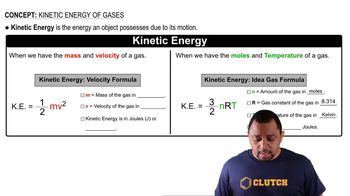
Kinetic energy (KE) is the energy an object possesses due to its motion, calculated using the formula KE = 0.5 * m * v², where m is mass and v is velocity. This formula shows that kinetic energy is directly proportional to both the mass of the object and the square of its velocity, meaning that even small changes in speed can significantly affect kinetic energy.
Video consigliato:
Percorso guidato
02:27
Kinetic Energy Formulas

Units of Measurement

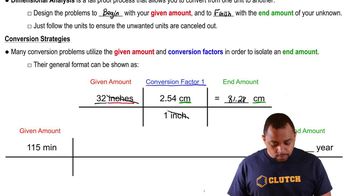
In this question, it is essential to ensure that all measurements are in compatible units. The car's speed is given in kilometers per hour (km/h), while the mass is in kilograms (kg). To calculate kinetic energy accurately, the speed should be converted to meters per second (m/s), as the standard unit of velocity in physics is m/s, ensuring consistency in calculations.
Video consigliato:
Percorso guidato
02:52
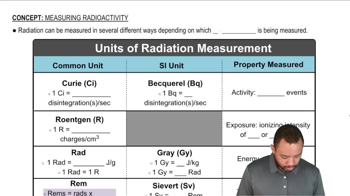
Units of Radiation Measurement

Comparative Analysis

To determine which object has more kinetic energy, a comparative analysis of the calculated kinetic energies of both the car and the truck is necessary. This involves substituting the respective mass and velocity values into the kinetic energy formula and comparing the results. Understanding how to interpret these results is crucial for drawing conclusions about the relative kinetic energies of the two vehicles.
Video consigliato:
Percorso guidato
06:11
Dimensional Analysis