Ch.1 - Matter, Measurement & Problem Solving
Tro - Chemistry: A Molecular Approach 4th Edition
Tro4th EditionChemistry: A Molecular ApproachISBN: 9780134112831Non è quello che usi tu?Cambia libro di testo
Capitolo 1, Problema 89

A flask containing 11.7 mL of a liquid weighs 132.8 g with the liquid in the flask and 124.1 g when empty. Calculate the density of the liquid in g/mL to the correct number of significant digits.

Guida verificata passo dopo passo
1
Calculate the mass of the liquid by subtracting the mass of the empty flask from the mass of the flask with the liquid: \( m_{\text{liquid}} = 132.8\, \text{g} - 124.1\, \text{g} \).
Determine the volume of the liquid, which is given as 11.7 mL.
Use the formula for density: \( \text{Density} = \frac{\text{mass}}{\text{volume}} \).
Substitute the mass of the liquid and the volume into the density formula: \( \text{Density} = \frac{m_{\text{liquid}}}{11.7\, \text{mL}} \).
Ensure the final answer is reported with the correct number of significant figures based on the given data.

Risposta video verificata per un problema simile:

Questa soluzione video è stata consigliata dai nostri tutor come utile per risolvere questo problema.
Durata del video:
1m

Concetti chiave

Ecco i concetti essenziali che devi comprendere per rispondere correttamente alla domanda.

Density

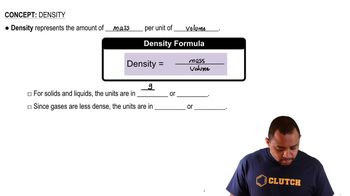
Density is defined as the mass of a substance divided by its volume, typically expressed in grams per milliliter (g/mL) for liquids. It is a crucial property that helps identify substances and understand their behavior in different conditions. The formula for density is D = m/V, where D is density, m is mass, and V is volume.
Video consigliato:
Percorso guidato
01:56
Density Concepts

Significant Figures

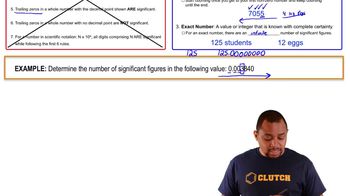
Significant figures are the digits in a number that contribute to its precision. This includes all non-zero digits, any zeros between them, and trailing zeros in the decimal portion. When performing calculations, it is essential to report the final answer with the correct number of significant figures based on the precision of the measurements involved.
Video consigliato:
Percorso guidato
01:09
Significant Figures Example

Mass Measurement

Mass measurement involves determining the amount of matter in an object, typically using a balance. In this context, the mass of the liquid is found by subtracting the mass of the empty flask from the mass of the flask with the liquid. Accurate mass measurement is vital for calculating density and ensuring that the results reflect the true properties of the substance.
Video consigliato:
Percorso guidato
02:52
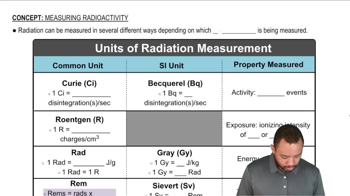
Units of Radiation Measurement