
Ch.1 - Matter, Measurement & Problem Solving
Tro - Chemistry: A Molecular Approach 4th Edition
Tro4th EditionChemistry: A Molecular ApproachISBN: 9780134112831Non è quello che usi tu?Cambia libro di testo
Capitolo 1, Problema 131

A length of #8 copper wire (radius = 1.63 mm) has a mass of 24.0 kg and a resistance of 2.061 ohm per km (Ω / km). What is the overall resistance of the wire?

Guida verificata passo dopo passo
1
Convert the mass of the copper wire to its volume using the density of copper (8.96 g/cm³).
Calculate the length of the wire using the volume and the cross-sectional area (A = πr², where r is the radius).
Convert the length of the wire from meters to kilometers to match the units of resistance per kilometer.
Use the given resistance per kilometer to find the total resistance by multiplying it by the length of the wire in kilometers.
Ensure all units are consistent and check calculations for any errors.

Risposta video verificata per un problema simile:

Questa soluzione video è stata consigliata dai nostri tutor come utile per risolvere questo problema.
Durata del video:
6m

Concetti chiave

Ecco i concetti essenziali che devi comprendere per rispondere correttamente alla domanda.

Resistance

Resistance is a measure of the opposition to the flow of electric current in a conductor. It is influenced by the material's properties, length, and cross-sectional area. The formula for resistance (R) is R = ρ(L/A), where ρ is the resistivity, L is the length, and A is the cross-sectional area. Understanding resistance is crucial for calculating how much current will flow through a wire for a given voltage.
Video consigliato:
Percorso guidato
02:47
Buffer Range Calculation

Ohm's Law

Ohm's Law states that the current (I) flowing through a conductor between two points is directly proportional to the voltage (V) across the two points and inversely proportional to the resistance (R). It is expressed as V = IR. This fundamental principle helps in understanding how voltage, current, and resistance interact in electrical circuits, which is essential for solving problems related to wire resistance.
Video consigliato:

Cross-sectional Area

The cross-sectional area of a wire is the area of its circular end face, which affects its resistance. It can be calculated using the formula A = πr², where r is the radius of the wire. A larger cross-sectional area results in lower resistance, allowing more current to flow. This concept is vital when determining the overall resistance of a wire, as it directly influences the resistance value.
Video consigliato:
Percorso guidato
03:47
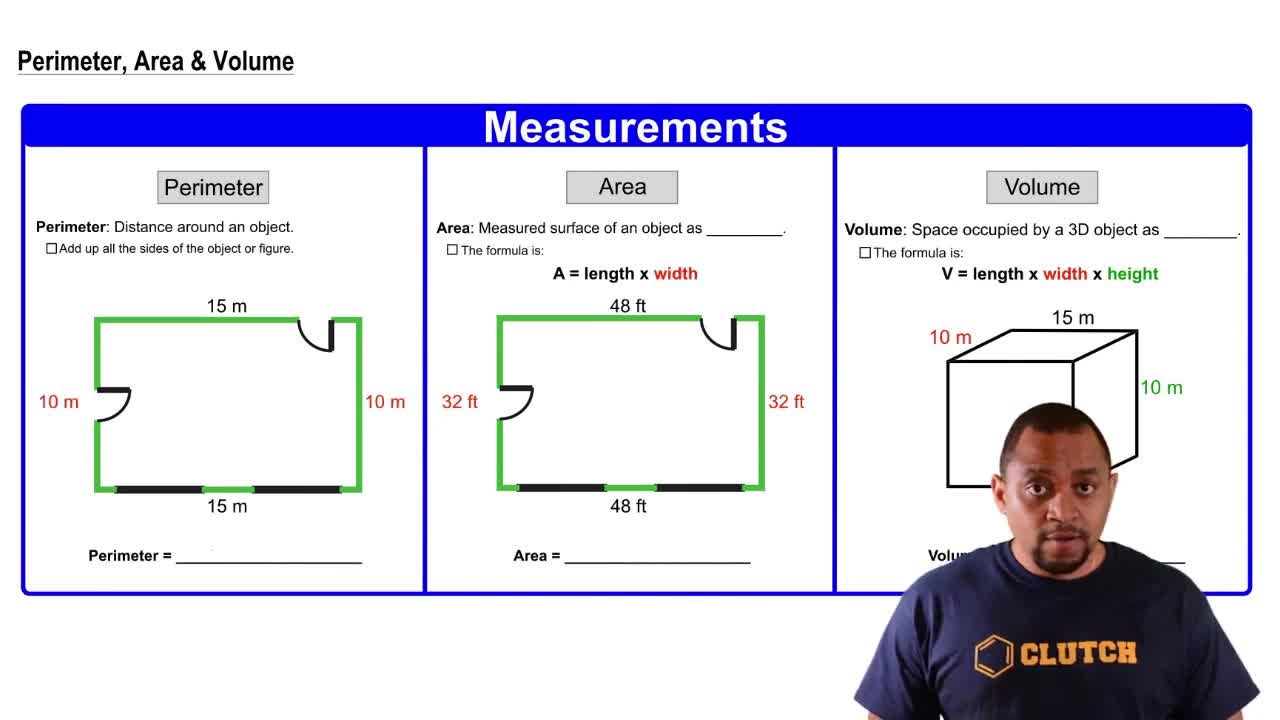
Perimeter, Area, Volume
Pratica correlata
Domanda del libro di testo

Mercury is often used in thermometers. The mercury sits in a bulb on the bottom of the thermometer and rises up a thin capillary as the temperature rises. Suppose a mercury thermometer contains 3.380 g of mercury and has a capillary that is 0.200 mm in diameter. How far does the mercury rise in the capillary when the temperature changes from 0.0 °C to 25.0 °C? The density of mercury at these temperatures is 13.596 g/cm3 and 13.534 g/cm3, respectively

1929
views
1
rank
Domanda del libro di testo

Lead metal can be extracted from a mineral called galena, which contains 86.6% lead by mass. A particular ore contains 68.5% galena by mass. If the lead can be extracted with 92.5% efficiency, what mass of ore is required to make a lead sphere with a 5.00-cm radius?

1468
views
1
comments
Domanda del libro di testo

The world's record in the 100-m dash is 9.69 s, and in the 100-yd dash it is 9.21 s. Find the speed in mi/hr of the runners who set these records. (Assume three significant figures for 100 m and 100 yd.)

735
views
Domanda del libro di testo

The daily recommended intake of calcium for an average adult is 1,000 mg. There is 125 mg of calcium in 100 grams of milk. If a 150 g smoothie contains 75 grams of milk, how many grams of smoothie should an adult consume to meet the daily recommended intake?

2101
views
2
comments
Domanda del libro di testo

Rolls of aluminum foil are 304 mm wide and 0.016 mm thick. What maximum length of aluminum foil can be made from 1.10 kg of aluminum?

2487
views
1
comments