Ch.1 - Matter, Measurement & Problem Solving
Tro - Chemistry: A Molecular Approach 4th Edition
Tro4th EditionChemistry: A Molecular ApproachISBN: 9780134112831Non è quello che usi tu?Cambia libro di testo
Capitolo 1, Problema 67

Glycerol is a syrupy liquid often used in cosmetics and soaps. A 3.25 L sample of pure glycerol has a mass of 4.10×10³ g. What is the density of glycerol in g/cm3?

Guida verificata passo dopo passo
1
Convert the volume from liters to cubic centimeters (cm^3) using the conversion factor: 1 L = 1000 cm^3.
Calculate the density using the formula: \( \text{Density} = \frac{\text{Mass}}{\text{Volume}} \).
Substitute the given mass (4.10 \(\times\) 10^3 \(\text{ g}\)) and the converted volume into the density formula.
Simplify the expression to find the density in g/cm^3.
Ensure the units are consistent and the final density is expressed in g/cm^3.

Risposta video verificata per un problema simile:

Questa soluzione video è stata consigliata dai nostri tutor come utile per risolvere questo problema.
Durata del video:
3m

Concetti chiave

Ecco i concetti essenziali che devi comprendere per rispondere correttamente alla domanda.

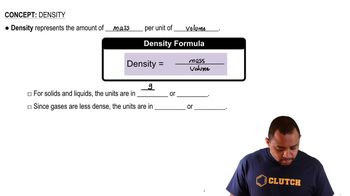
Density

Density is defined as the mass of a substance divided by its volume. It is typically expressed in units such as grams per cubic centimeter (g/cm³) or kilograms per liter (kg/L). Understanding density is crucial for determining how much mass is contained in a given volume of a substance, which is essential in various applications, including chemistry and material science.
Video consigliato:
Percorso guidato
01:56
Density Concepts

Mass and Volume

Mass is a measure of the amount of matter in an object, usually measured in grams (g) or kilograms (kg). Volume, on the other hand, is the amount of space that a substance occupies, commonly measured in liters (L) or cubic centimeters (cm³). In the context of calculating density, both mass and volume are necessary components, as density is derived from their relationship.
Video consigliato:
Percorso guidato
02:35
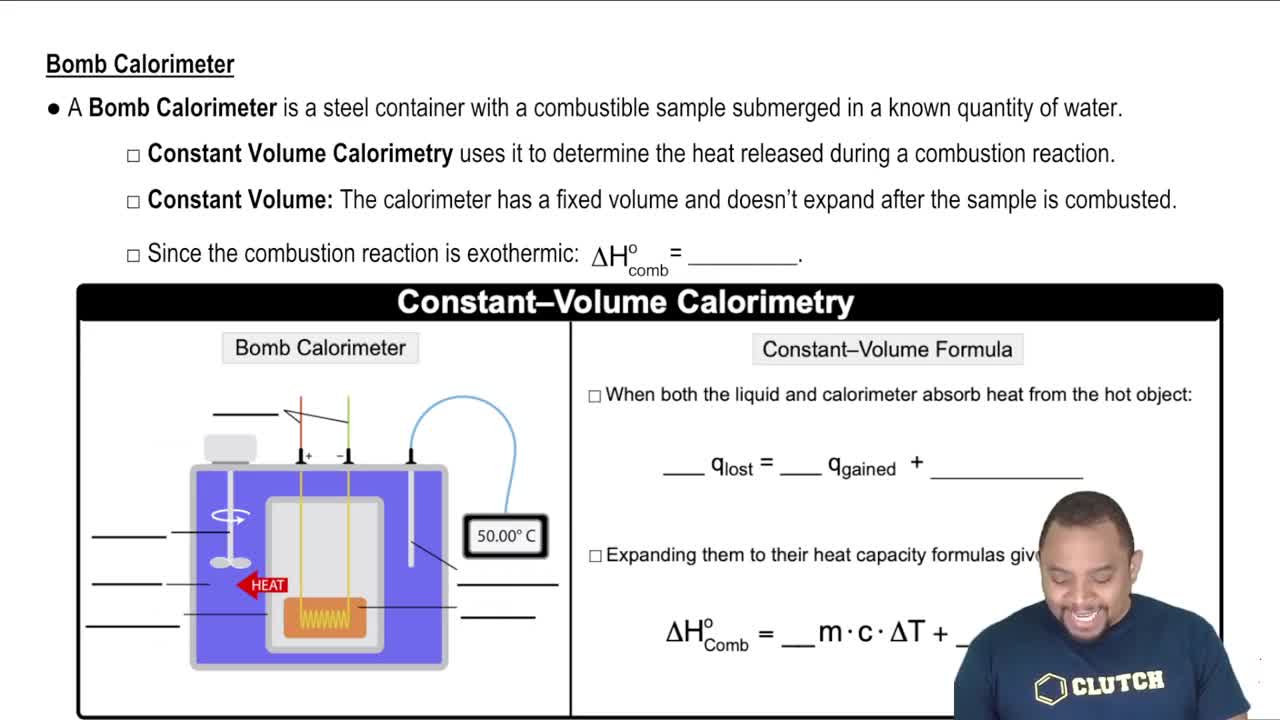
Constant-Volume Calorimetry

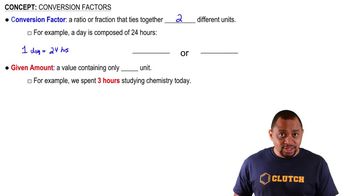
Unit Conversion

Unit conversion is the process of converting a quantity expressed in one set of units to another. In this question, it is important to ensure that the volume of glycerol is expressed in cubic centimeters (cm³) to match the density units of g/cm³. Understanding how to convert between liters and cubic centimeters (1 L = 1000 cm³) is essential for accurate calculations in chemistry.
Video consigliato:
Percorso guidato
01:56
Conversion Factors