Ch.1 - Matter, Measurement & Problem Solving
Tro - Chemistry: A Molecular Approach 4th Edition
Tro4th EditionChemistry: A Molecular ApproachISBN: 9780134112831Non è quello che usi tu?Cambia libro di testo
Capitolo 1, Problema 55d

Use the prefix multipliers to express each measurement without exponents. d. 3.5×10⁶ L

Guida verificata passo dopo passo
1
Identify the prefix multiplier that corresponds to the exponent in the measurement. In this case, the exponent is 6, which corresponds to the prefix 'mega' (M), meaning 10^6.
Rewrite the measurement using the identified prefix. Replace 10^6 with the prefix 'M'.
Express the measurement as 3.5 ML, where 'M' stands for 'mega'.
Ensure that the unit 'L' (liters) is correctly associated with the prefix 'M'.
Verify that the conversion is correct by checking that 3.5 ML is equivalent to 3.5 * 10^6 L.

Risposta video verificata per un problema simile:

Questa soluzione video è stata consigliata dai nostri tutor come utile per risolvere questo problema.
Durata del video:
2m

Concetti chiave

Ecco i concetti essenziali che devi comprendere per rispondere correttamente alla domanda.

Scientific Notation

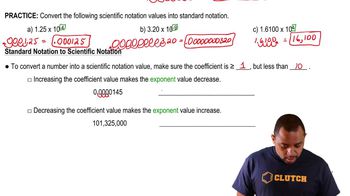
Scientific notation is a way of expressing numbers that are too large or too small to be conveniently written in decimal form. It is typically formatted as a product of a number between 1 and 10 and a power of ten. For example, 3.5 * 10^6 means 3.5 multiplied by 1,000,000, which equals 3,500,000.
Video consigliato:
Percorso guidato
02:50
Standard Notation to Scientific Notation

Metric Prefixes

Metric prefixes are used to denote specific powers of ten in the metric system, allowing for easier communication of measurements. Common prefixes include 'kilo-' (10^3), 'mega-' (10^6), and 'giga-' (10^9). In the case of 3.5 * 10^6 L, the appropriate prefix is 'mega-', so it can be expressed as 3.5 ML.
Video consigliato:
Percorso guidato
01:16
Metric Prefixes Usage

Unit Conversion

Unit conversion involves changing a measurement from one unit to another while maintaining the same quantity. In this context, converting from liters to megaliters requires understanding the relationship between the units, specifically that 1 ML equals 1,000 L. This conversion is essential for expressing large quantities in a more manageable form.
Video consigliato:
Percorso guidato
01:56
Conversion Factors