Domanda del libro di testo
The valence electron configurations of several atoms are shown here. How many bonds can each atom make without hybridization? c. O 2s22p4
427
views

 Tro 4th EditionCh.10 - Chemical Bonding II: Molecular Shapes & Valence Bond TheoryProblema 53b
 Guida verificata passo dopo passo
 02:12
02:12
 02:19
02:19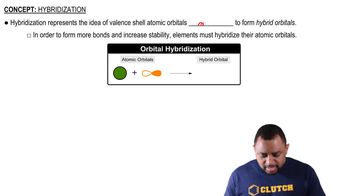 00:51
00:51The valence electron configurations of several atoms are shown here. How many bonds can each atom make without hybridization? c. O 2s22p4
The valence electron configurations of several atoms are shown here. How many bonds can each atom make without hybridization? a. Be 2s2
Determine whether each molecule is polar or nonpolar. a. SiCl4 b. CF2Cl2 c. SeF6 d. IF5
Determine whether each molecule is polar or nonpolar. a. SCl2 b. SCl4
The valence electron configurations of several atoms are shown here. How many bonds can each atom make without hybridization? c. F 2s22p5
The valence electron configurations of several atoms are shown here. How many bonds can each atom make without hybridization? a. B 2s22p1 b. N 2s22p3