Domanda del libro di testo
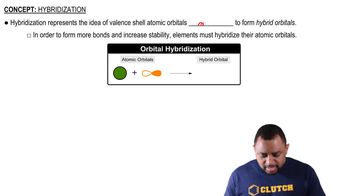
Sketch the bonding molecular orbital that results from the linear combination of two 1s orbitals. Indicate the region where interference occurs and state the kind of interference (constructive or destructive).
1214
views

 Tro 4th EditionCh.10 - Chemical Bonding II: Molecular Shapes & Valence Bond TheoryProblema 68
 Guida verificata passo dopo passo
 00:51
00:51
 02:15
02:15 02:10
02:10Sketch the bonding molecular orbital that results from the linear combination of two 1s orbitals. Indicate the region where interference occurs and state the kind of interference (constructive or destructive).
Draw an MO energy diagram and predict the bond order of Li2+ and Li2-. Do you expect these molecules to exist in the gas phase?
Draw an MO energy diagram and predict the bond order of Be2+ and Be2- . Do you expect these molecules to exist in the gas phase?
Write a hybridization and bonding scheme for each molecule that contains more than one interior atom. Indicate the hybridization about each interior atom. Sketch the structure, including overlapping orbitals, and label all bonds using the notation shown in Examples 10.6 and 10.7. a. N2H2 (skeletal structure HNNH) b. N2H4 (skeletal structure H2NNH2) c. CH3NH2 (skeletal structure H3CNH2)
Write a hybridization and bonding scheme for each molecule that contains more than one interior atom. Indicate the hybridization about each interior atom. Sketch the structure, including overlapping orbitals, and label all bonds using the notation shown in Examples 10.6 and 10.7. c. C2H6 (skeletal structure H3CCH3)
Consider the structure of the amino acid alanine. Indicate the hybridization about each interior atom.