Ch.10 - Chemical Bonding II: Molecular Shapes & Valence Bond Theory
Tro - Chemistry: A Molecular Approach 4th Edition
Tro4th EditionChemistry: A Molecular ApproachISBN: 9780134112831Non è quello che usi tu?Cambia libro di testo
Capitolo 10, Problema 81

Draw an MO energy diagram for CO. (Use the energy ordering of O2.) Predict the bond order and make a sketch of the lowest energy bonding molecular orbital.

Guida verificata passo dopo passo
1
Identify the atomic orbitals involved: For CO, consider the 2s and 2p orbitals of both carbon and oxygen.
Determine the energy ordering: Use the energy ordering of O2, which is \( \sigma_{2s} < \sigma^*_{2s} < \sigma_{2p_z} < \pi_{2p_x} = \pi_{2p_y} < \pi^*_{2p_x} = \pi^*_{2p_y} < \sigma^*_{2p_z} \).
Fill the molecular orbitals with electrons: CO has a total of 10 valence electrons (4 from C and 6 from O). Fill the MOs starting from the lowest energy level.
Calculate the bond order: Use the formula \( \text{Bond Order} = \frac{(\text{Number of bonding electrons}) - (\text{Number of antibonding electrons})}{2} \).
Sketch the lowest energy bonding molecular orbital: The lowest energy bonding MO is \( \sigma_{2s} \), which is a sigma bond formed by the overlap of the 2s orbitals of C and O.

Risposta video verificata per un problema simile:

Questa soluzione video è stata consigliata dai nostri tutor come utile per risolvere questo problema.
Durata del video:
2m

Concetti chiave

Ecco i concetti essenziali che devi comprendere per rispondere correttamente alla domanda.

Molecular Orbital Theory

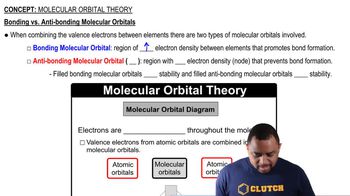
Molecular Orbital (MO) Theory describes how atomic orbitals combine to form molecular orbitals that can be occupied by electrons. In this theory, electrons are delocalized over the entire molecule rather than being confined to individual atoms. The energy levels of these molecular orbitals are determined by the energies of the atomic orbitals involved in their formation, leading to bonding and antibonding interactions.
Video consigliato:
Percorso guidato
03:06
Molecular Orbital Theory

Bond Order

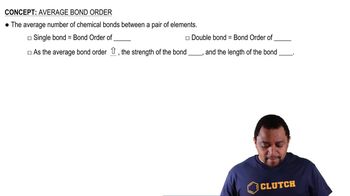
Bond order is a measure of the number of chemical bonds between a pair of atoms, calculated as the difference between the number of bonding and antibonding electrons divided by two. It provides insight into the stability and strength of a bond; a higher bond order indicates a stronger bond. For example, a bond order of 1 corresponds to a single bond, while a bond order of 2 indicates a double bond.
Video consigliato:
Percorso guidato
00:36
Average Bond Order

Energy Ordering of Molecular Orbitals

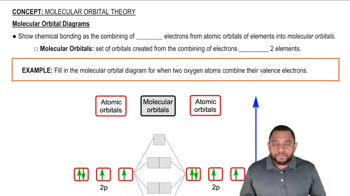
The energy ordering of molecular orbitals is crucial for predicting the electronic structure of a molecule. For diatomic molecules like CO, the relative energies of the molecular orbitals can be influenced by the atomic orbitals of the constituent atoms. In the case of CO, the energy ordering follows that of O2, where the σ2s and σ*2s orbitals are lower in energy than the σ2p and π2p orbitals, affecting the overall bond characteristics.
Video consigliato:
Percorso guidato
04:12
Molecular Orbital Diagram