
Ch.11 - Liquids, Solids & Intermolecular Forces
Tro - Chemistry: A Molecular Approach 4th Edition
Tro4th EditionChemistry: A Molecular ApproachISBN: 9780134112831Non è quello che usi tu?Cambia libro di testo
Capitolo 11, Problema 90

A sample of steam with a mass of 0.552 g and at a temperature of 100 °C condenses into an insulated container holding 4.25 g of water at 5.0 °C. Assuming that no heat is lost to the surroundings, what is the final temperature of the mixture?

Guida verificata passo dopo passo
1
Identify the process: The steam will first condense into water at 100 °C, releasing heat, and then the resulting water will cool down to reach thermal equilibrium with the water initially in the container.
Calculate the heat released during the condensation of steam using the formula: \( q_\text{condensation} = m_\text{steam} \times \Delta H_\text{vap} \), where \( \Delta H_\text{vap} \) is the heat of vaporization of water.
Calculate the heat lost by the condensed steam as it cools from 100 °C to the final temperature \( T_f \) using: \( q_\text{cooling} = m_\text{condensed water} \times c_\text{water} \times (T_f - 100) \), where \( c_\text{water} \) is the specific heat capacity of water.
Calculate the heat gained by the initial water in the container as it warms from 5.0 °C to \( T_f \) using: \( q_\text{warming} = m_\text{initial water} \times c_\text{water} \times (T_f - 5) \).
Set the total heat lost by the steam equal to the total heat gained by the initial water and solve for the final temperature \( T_f \).

Risposta video verificata per un problema simile:

Questa soluzione video è stata consigliata dai nostri tutor come utile per risolvere questo problema.
Durata del video:
7m

Concetti chiave

Ecco i concetti essenziali che devi comprendere per rispondere correttamente alla domanda.

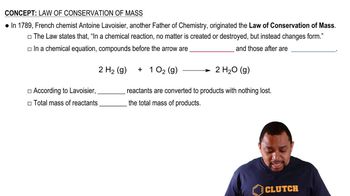
Heat Transfer and Conservation of Energy

In thermodynamics, the principle of conservation of energy states that energy cannot be created or destroyed, only transformed. In this scenario, the heat lost by the steam as it condenses and cools must equal the heat gained by the water as it warms up. This relationship allows us to set up an equation to solve for the final temperature of the mixture.
Video consigliato:
Percorso guidato
01:48
Law of Conservation of Mass

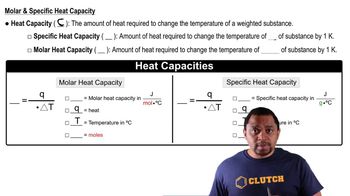
Specific Heat Capacity

Specific heat capacity is the amount of heat required to raise the temperature of a unit mass of a substance by one degree Celsius. Different substances have different specific heat capacities, which affect how they respond to heat transfer. In this problem, the specific heat capacities of steam and water will be crucial for calculating the heat exchange during the condensation and warming processes.
Video consigliato:

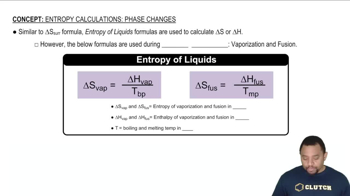
Phase Change and Latent Heat

Phase changes, such as the condensation of steam into water, involve latent heat, which is the heat absorbed or released during a phase transition without a change in temperature. The latent heat of vaporization for water is significant in this problem, as it quantifies the energy released when steam condenses. Understanding this concept is essential for accurately calculating the heat transfer involved in the process.
Video consigliato:
Percorso guidato
01:46
Entropy in Phase Changes