Ch.11 - Liquids, Solids & Intermolecular Forces
Tro - Chemistry: A Molecular Approach 4th Edition
Tro4th EditionChemistry: A Molecular ApproachISBN: 9780134112831Non è quello che usi tu?Cambia libro di testo
Capitolo 11, Problema 36c

Determine the kinds of intermolecular forces that are present in each element or compound. c. SiH4

Guida verificata passo dopo passo
1
Identify the molecular structure of SiH_4. Silicon (Si) is the central atom bonded to four hydrogen (H) atoms, forming a tetrahedral shape.
Determine the polarity of the Si-H bonds. Silicon and hydrogen have different electronegativities, but the difference is not large enough to make the bonds significantly polar.
Assess the overall polarity of the SiH_4 molecule. Due to its symmetrical tetrahedral shape, any dipole moments in the Si-H bonds cancel out, making SiH_4 a nonpolar molecule.
Identify the types of intermolecular forces present in nonpolar molecules. Nonpolar molecules like SiH_4 primarily exhibit London dispersion forces (also known as van der Waals forces).
Conclude that the only intermolecular forces present in SiH_4 are London dispersion forces, which are the weakest type of intermolecular force.

Risposta video verificata per un problema simile:

Questa soluzione video è stata consigliata dai nostri tutor come utile per risolvere questo problema.
Durata del video:
2m

Concetti chiave

Ecco i concetti essenziali che devi comprendere per rispondere correttamente alla domanda.

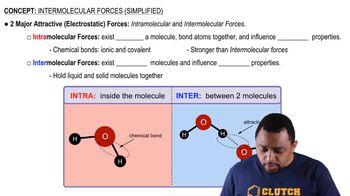
Intermolecular Forces

Intermolecular forces are the attractive forces between molecules that influence physical properties such as boiling and melting points. These forces include hydrogen bonding, dipole-dipole interactions, and London dispersion forces. Understanding these forces is crucial for predicting the behavior of substances in different states of matter.
Video consigliato:
Percorso guidato
01:59
Intermolecular vs Intramolecular Forces

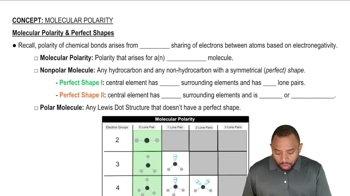
Molecular Polarity

Molecular polarity refers to the distribution of electrical charge across a molecule, which determines whether it has a positive or negative end. Polar molecules have a significant difference in electronegativity between atoms, leading to dipole moments, while nonpolar molecules have an even distribution of charge. The polarity of a molecule affects the type of intermolecular forces it can exhibit.
Video consigliato:
Percorso guidato
02:38
Molecular Polarity

Silane (SiH4) Structure

Silane (SiH4) is a molecular compound consisting of silicon and hydrogen. It has a tetrahedral geometry, with silicon at the center and four hydrogen atoms at the corners. Due to its symmetrical structure and nonpolar Si-H bonds, SiH4 is a nonpolar molecule, primarily exhibiting London dispersion forces as its intermolecular force.
Video consigliato:
Percorso guidato
01:42
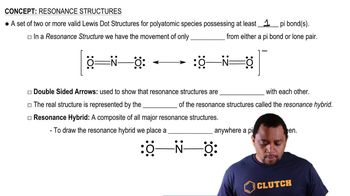
Resonance Structures