Ch.11 - Liquids, Solids & Intermolecular Forces
Tro - Chemistry: A Molecular Approach 4th Edition
Tro4th EditionChemistry: A Molecular ApproachISBN: 9780134112831Non è quello che usi tu?Cambia libro di testo
Capitolo 11, Problema 38a,b

Determine the kinds of intermolecular forces that are present in each element or compound. a. PH3 b. HBr

Guida verificata passo dopo passo
1
Identify the types of intermolecular forces: London dispersion forces, dipole-dipole interactions, and hydrogen bonding.
For PH_3: Recognize that PH_3 is a polar molecule due to the difference in electronegativity between P and H, leading to dipole-dipole interactions. Also, note that PH_3 does not have hydrogen bonding because hydrogen is not bonded to N, O, or F.
For PH_3: Acknowledge that all molecules, including PH_3, exhibit London dispersion forces due to temporary dipoles.
For HBr: Determine that HBr is a polar molecule because of the electronegativity difference between H and Br, resulting in dipole-dipole interactions.
For HBr: Understand that HBr also exhibits London dispersion forces, as these are present in all molecules.

Risposta video verificata per un problema simile:

Questa soluzione video è stata consigliata dai nostri tutor come utile per risolvere questo problema.
Durata del video:
2m

Concetti chiave

Ecco i concetti essenziali che devi comprendere per rispondere correttamente alla domanda.

Intermolecular Forces

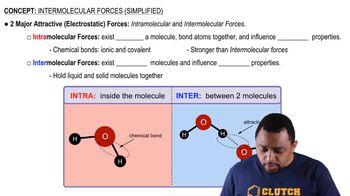
Intermolecular forces are the attractive forces between molecules that influence physical properties such as boiling and melting points. The main types include hydrogen bonding, dipole-dipole interactions, and London dispersion forces. Understanding these forces is crucial for predicting the behavior of substances in different states and conditions.
Video consigliato:
Percorso guidato
01:59
Intermolecular vs Intramolecular Forces

Polarity

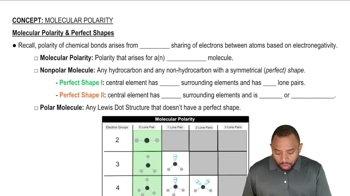
Polarity refers to the distribution of electrical charge over the atoms in a molecule. A molecule is polar if it has a significant difference in electronegativity between its atoms, leading to a dipole moment. For example, HBr is polar due to the difference in electronegativity between hydrogen and bromine, while PH3 is less polar, affecting the types of intermolecular forces present.
Video consigliato:
Percorso guidato
02:38
Molecular Polarity

Hydrogen Bonding

Hydrogen bonding is a specific type of strong dipole-dipole interaction that occurs when hydrogen is bonded to highly electronegative atoms like nitrogen, oxygen, or fluorine. In the case of PH3, hydrogen bonding is not significant, while HBr exhibits dipole-dipole interactions. Recognizing the presence and strength of hydrogen bonds is essential for understanding the properties of compounds.
Video consigliato:
Percorso guidato
01:22
Hydrogenation Reactions