Ch.11 - Liquids, Solids & Intermolecular Forces
Tro - Chemistry: A Molecular Approach 4th Edition
Tro4th EditionChemistry: A Molecular ApproachISBN: 9780134112831Non è quello che usi tu?Cambia libro di testo
Capitolo 11, Problema 84

Explain the observed trend in the boiling points of these compounds.
H2Te -2 °C
H2Se -41.5 °C
H2S -60.7 °C
H2O 100 °C

Guida verificata passo dopo passo
1
Identify the compounds and their respective boiling points: H2Te (-2 °C), H2Se (-41.5 °C), H2S (-60.7 °C), and H2O (100 °C).
Recognize that these compounds are hydrides of Group 16 elements (chalcogens) in the periodic table.
Understand that boiling points are influenced by intermolecular forces, such as hydrogen bonding, dipole-dipole interactions, and London dispersion forces.
Note that H2O has a significantly higher boiling point due to strong hydrogen bonding, which is absent or weaker in the other hydrides.
Observe that the trend in boiling points for H2Te, H2Se, and H2S is influenced by increasing molecular weight and size, leading to stronger London dispersion forces.

Risposta video verificata per un problema simile:

Questa soluzione video è stata consigliata dai nostri tutor come utile per risolvere questo problema.
Durata del video:
1m

Concetti chiave

Ecco i concetti essenziali che devi comprendere per rispondere correttamente alla domanda.

Intermolecular Forces

Intermolecular forces are the attractive forces between molecules that influence physical properties such as boiling points. The main types include hydrogen bonding, dipole-dipole interactions, and London dispersion forces. Stronger intermolecular forces typically result in higher boiling points, as more energy is required to separate the molecules.
Video consigliato:
Percorso guidato
01:59
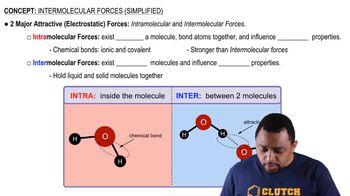
Intermolecular vs Intramolecular Forces

Hydrogen Bonding

Hydrogen bonding is a specific type of strong dipole-dipole interaction that occurs when hydrogen is bonded to highly electronegative atoms like oxygen, nitrogen, or fluorine. In the case of water (H2O), the presence of hydrogen bonds significantly raises its boiling point compared to other similar compounds, such as H2S and H2Se, which lack this strong interaction.
Video consigliato:
Percorso guidato
01:22
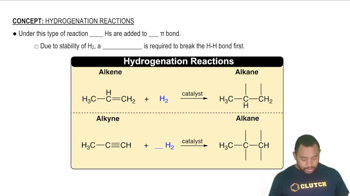
Hydrogenation Reactions

Molecular Weight and Structure

Molecular weight and structure also play a crucial role in determining boiling points. Generally, larger molecules with greater molecular weights exhibit higher boiling points due to increased London dispersion forces. However, the presence of polar bonds and the ability to form hydrogen bonds can override this trend, as seen in the comparison of H2O with the other compounds listed.
Video consigliato:
Percorso guidato
01:09
Structural Formula Example