
Ch.11 - Liquids, Solids & Intermolecular Forces
Tro - Chemistry: A Molecular Approach 4th Edition
Tro4th EditionChemistry: A Molecular ApproachISBN: 9780134112831Non è quello che usi tu?Cambia libro di testo
Capitolo 11, Problema 57

The human body obtains 915 kJ of energy from a candy bar. If this energy were used to vaporize water at 100.0 °C, how much water (in liters) could be vaporized? (Assume the density of water is 1.00 g/mL.)

Guida verificata passo dopo passo
1
Identify the energy required to vaporize water, which is the heat of vaporization (\(\Delta H_{vap}\)) for water at 100.0 °C. This value is typically 40.7 kJ/mol.
Convert the energy obtained from the candy bar from kilojoules to joules. Since 1 kJ = 1000 J, multiply 915 kJ by 1000 to get the energy in joules.
Calculate the number of moles of water that can be vaporized using the energy from the candy bar. Use the formula: \(\text{moles of water} = \frac{\text{energy in joules}}{\Delta H_{vap} \times 1000}\), where \(\Delta H_{vap}\) is in kJ/mol.
Convert the moles of water to grams using the molar mass of water (18.02 g/mol). Use the formula: \(\text{mass of water (g)} = \text{moles of water} \times 18.02\, \text{g/mol}\).
Convert the mass of water in grams to volume in liters. Since the density of water is 1.00 g/mL, the volume in mL is equal to the mass in grams. Convert mL to liters by dividing by 1000.

Concetti chiave

Ecco i concetti essenziali che devi comprendere per rispondere correttamente alla domanda.

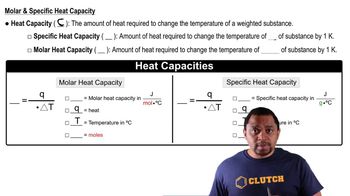
Heat of Vaporization

The heat of vaporization is the amount of energy required to convert a unit mass of a liquid into vapor without a change in temperature. For water, this value is approximately 2260 J/g at 100 °C. Understanding this concept is crucial for calculating how much water can be vaporized using a given amount of energy.
Video consigliato:

Energy Conversion

Energy conversion involves changing energy from one form to another. In this context, the energy obtained from the candy bar (915 kJ) must be converted into joules (1 kJ = 1000 J) to match the units used for the heat of vaporization. This step is essential for accurately determining the amount of water that can be vaporized.
Video consigliato:
Percorso guidato
01:56
Conversion Factors

Density of Water

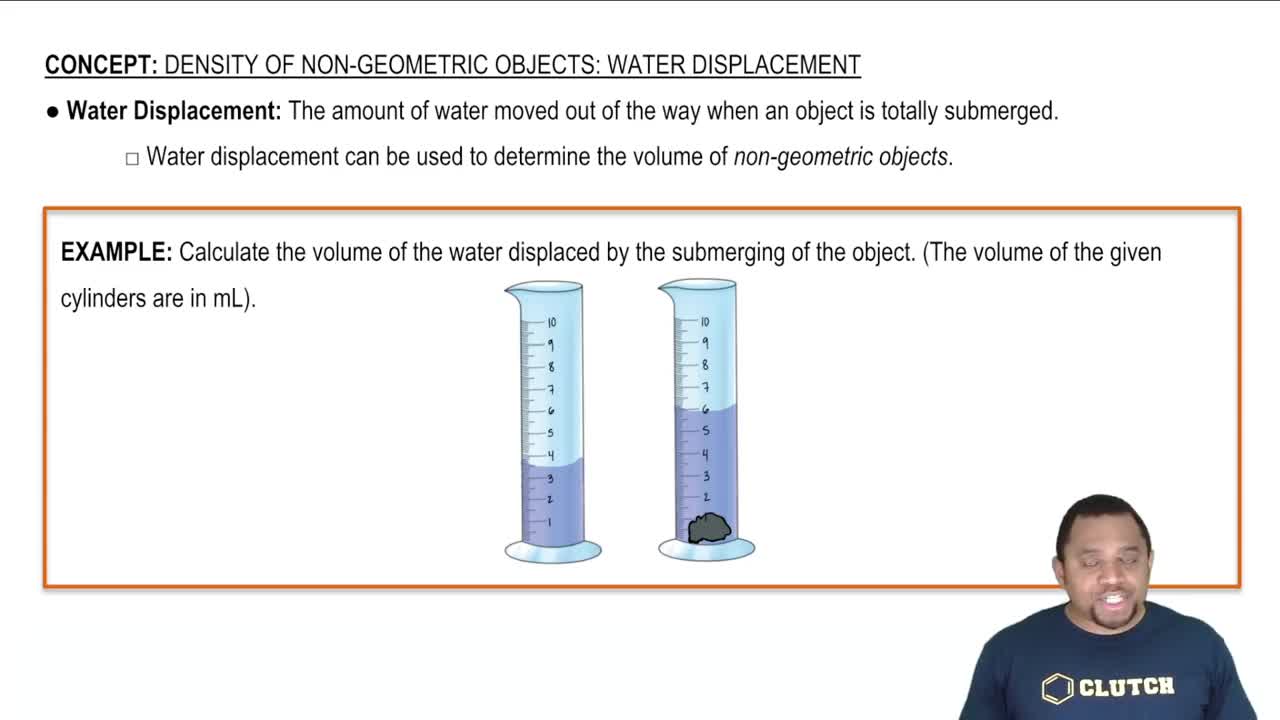
Density is defined as mass per unit volume, and for water, it is typically 1.00 g/mL at standard conditions. This property allows for the conversion between mass and volume, which is necessary when calculating how many liters of water can be vaporized based on the mass of water that corresponds to the energy provided.
Video consigliato:
Percorso guidato
01:36
Density via Water Displacement