Ch.11 - Liquids, Solids & Intermolecular Forces
Tro - Chemistry: A Molecular Approach 4th Edition
Tro4th EditionChemistry: A Molecular ApproachISBN: 9780134112831Non è quello che usi tu?Cambia libro di testo
Capitolo 11, Problema 53

Which evaporates more quickly: 55 mL of water in a beaker with a diameter of 4.5 cm or 55 mL of water in a dish with a diameter of 12 cm, and is the vapor pressure of the water different in the two containers? Explain.

Guida verificata passo dopo passo
1
Step 1: Understand the concept of evaporation. Evaporation is the process where molecules at the surface of a liquid gain enough energy to enter the gaseous phase.
Step 2: Consider the surface area of the liquid. The rate of evaporation is directly proportional to the surface area exposed to air.
Step 3: Compare the surface areas of the two containers. Calculate the surface area of the water in each container using the formula for the area of a circle, A = \(\pi\) r^2, where r is the radius.
Step 4: Analyze the relationship between surface area and evaporation rate. The container with the larger surface area will have a higher rate of evaporation.
Step 5: Discuss vapor pressure. Vapor pressure is a property of the liquid itself and is not affected by the shape or size of the container, so it remains the same in both containers.

Concetti chiave

Ecco i concetti essenziali che devi comprendere per rispondere correttamente alla domanda.

Surface Area and Evaporation

The rate of evaporation of a liquid is influenced by its surface area. A larger surface area allows more molecules to escape into the vapor phase, increasing the rate of evaporation. In this case, the dish with a diameter of 12 cm has a greater surface area compared to the beaker, which will lead to faster evaporation of the water in the dish.
Video consigliato:
Percorso guidato
04:50
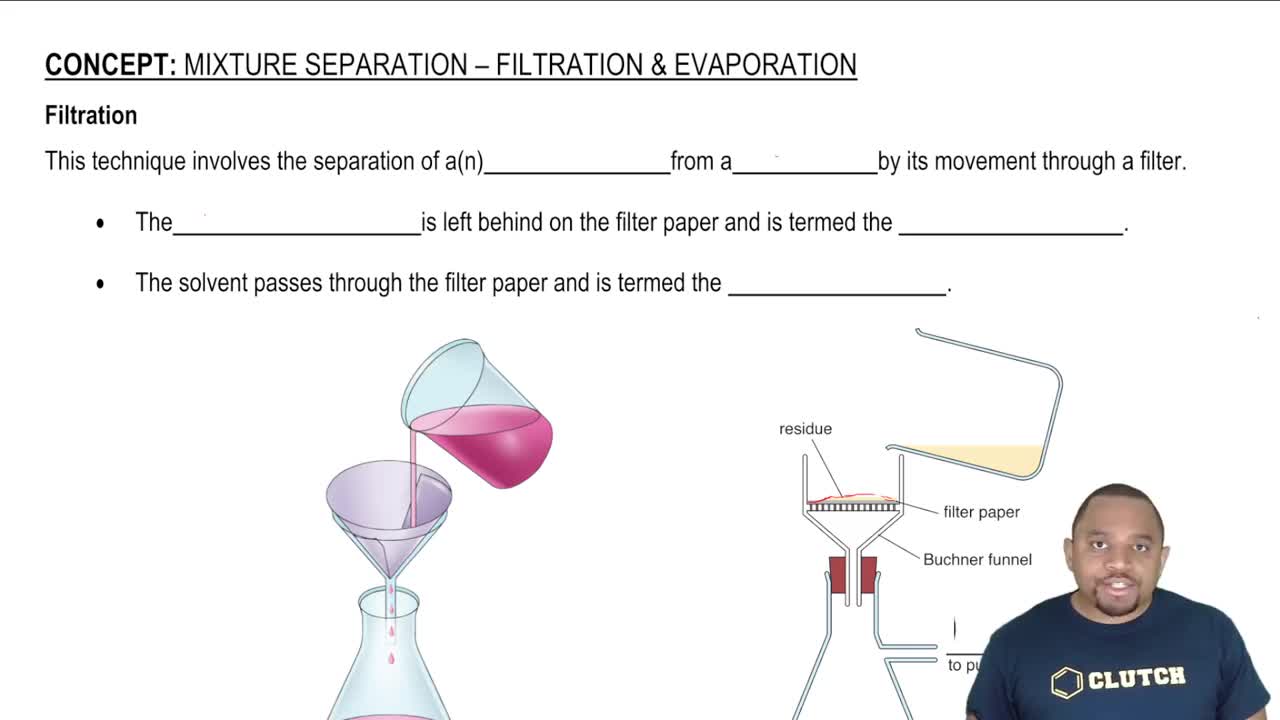
Filtration and Evaporation

Vapor Pressure

Vapor pressure is the pressure exerted by a vapor in equilibrium with its liquid at a given temperature. It is a measure of the tendency of molecules to escape from the liquid phase into the vapor phase. The vapor pressure of water remains the same regardless of the container's shape or size, as long as the temperature is constant, meaning it does not differ between the beaker and the dish.
Video consigliato:
Percorso guidato
02:40
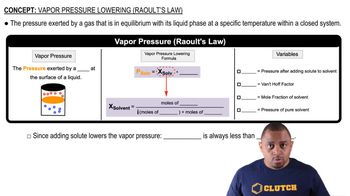
Raoult's Law and Vapor Pressure

Temperature and Evaporation Rate

The temperature of a liquid significantly affects its evaporation rate. Higher temperatures increase the kinetic energy of molecules, leading to a higher rate of evaporation. In both containers, if the temperature is constant, the primary factor affecting evaporation will be the surface area, but temperature changes can also influence the overall process.
Video consigliato:
Percorso guidato
04:50
Filtration and Evaporation