Ch.12 - Solids and Modern Material
Tro - Chemistry: A Molecular Approach 4th Edition
Tro4th EditionChemistry: A Molecular ApproachISBN: 9780134112831Non è quello che usi tu?Cambia libro di testo
Capitolo 12, Problema 53c

Classify each of the following as a component of a silicate ceramic, an oxide ceramic, or a nonoxide ceramic. c. MoSi2

Guida verificata passo dopo passo
1
Identify the chemical formula given: MoSi_{2}.
Recognize that MoSi_{2} consists of molybdenum (Mo) and silicon (Si).
Understand that silicate ceramics typically contain silicon and oxygen, forming silicate structures.
Note that oxide ceramics are composed of metal oxides, which include oxygen in their structure.
Determine that MoSi_{2} does not contain oxygen, classifying it as a nonoxide ceramic.

Risposta video verificata per un problema simile:

Questa soluzione video è stata consigliata dai nostri tutor come utile per risolvere questo problema.
Durata del video:
1m

Concetti chiave

Ecco i concetti essenziali che devi comprendere per rispondere correttamente alla domanda.

Silicate Ceramics

Silicate ceramics are materials primarily composed of silicon and oxygen, often combined with various metal oxides. They are known for their high melting points, chemical stability, and mechanical strength. Common examples include clay and glass, which are widely used in construction and pottery.
Video consigliato:
Percorso guidato
01:26
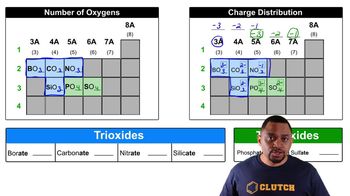
Polyatomic Oxyanion Names

Oxide Ceramics

Oxide ceramics are made from metal oxides, such as alumina (Al2O3) and zirconia (ZrO2). These materials exhibit excellent thermal and chemical stability, making them suitable for high-temperature applications. They are often used in electrical insulators and cutting tools due to their hardness and resistance to wear.
Video consigliato:
Percorso guidato
00:58
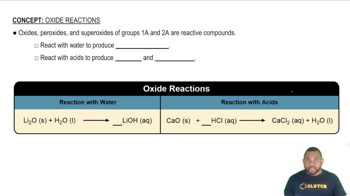
Oxide Reactions

Nonoxide Ceramics

Nonoxide ceramics include materials that do not contain oxygen in their primary composition, such as carbides, nitrides, and borides. These ceramics are typically characterized by their high hardness, thermal conductivity, and resistance to wear. An example is molybdenum disilicide (MoSi2), which is used in high-temperature applications due to its ability to withstand extreme conditions.