Ch.12 - Solids and Modern Material
Tro - Chemistry: A Molecular Approach 4th Edition
Tro4th EditionChemistry: A Molecular ApproachISBN: 9780134112831Non è quello che usi tu?Cambia libro di testo
Capitolo 12, Problema 49

Is the structure of each of the two unit cells shown in Problem 47 identifiable as the rock salt structure, zinc blende structure, fluorite structure, antifluorite structure, or is it none of these?

Guida verificata passo dopo passo
1
insert step 1> Identify the characteristics of each structure: Rock salt (NaCl) has a face-centered cubic (FCC) lattice with each ion type occupying octahedral sites. Zinc blende (ZnS) has a cubic close-packed (CCP) lattice with one ion type occupying tetrahedral sites. Fluorite (CaF2) has a cubic structure where the cations form a simple cubic lattice and the anions occupy all the tetrahedral sites. Antifluorite is the inverse of fluorite, where anions form a simple cubic lattice and cations occupy all the tetrahedral sites.
insert step 2> Examine the coordination number and the arrangement of ions in the given unit cells.
insert step 3> Compare the observed coordination numbers and lattice types with those of the known structures.
insert step 4> Determine if the unit cell matches any of the known structures based on the coordination and lattice type.
insert step 5> Conclude whether each unit cell corresponds to rock salt, zinc blende, fluorite, antifluorite, or none of these based on the analysis.

Concetti chiave

Ecco i concetti essenziali che devi comprendere per rispondere correttamente alla domanda.

Unit Cell Structures

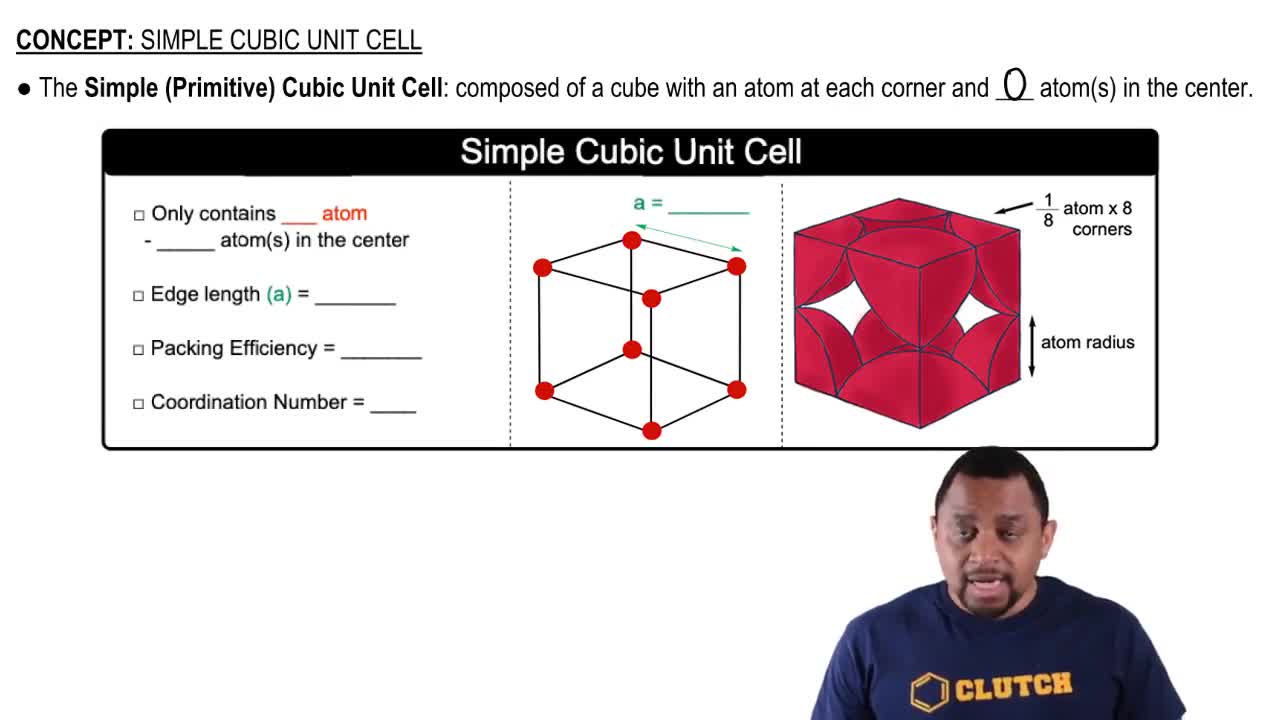
Unit cells are the smallest repeating units in a crystal lattice that define the structure of the entire crystal. They are characterized by their dimensions and the arrangement of atoms within them. Understanding the geometry and coordination of atoms in unit cells is essential for identifying specific crystal structures.
Video consigliato:
Percorso guidato
01:27
Simple Cubic Unit Cell

Rock Salt Structure

The rock salt structure, also known as the sodium chloride structure, features a face-centered cubic lattice where each sodium ion is surrounded by six chloride ions and vice versa. This arrangement leads to a coordination number of 6 for both types of ions, which is a key characteristic for identifying this structure in crystalline materials.
Video consigliato:

Zinc Blende Structure

The zinc blende structure, or sphalerite structure, is characterized by a face-centered cubic lattice where zinc ions are tetrahedrally coordinated by sulfide ions. This results in a coordination number of 4 for both ions. Recognizing this arrangement is crucial for distinguishing it from other structures like rock salt or fluorite.
Video consigliato:
Percorso guidato
01:42
Resonance Structures