
A solution contains 50.0 g of heptane (C7H16) and 50.0 g of octane (C8H18) at 25 °C. The vapor pressures of pure heptane and pure octane at 25 °C are 45.8 torr and 10.9 torr, respectively. Assuming ideal behavior, answer the following: d. Why is the composition of the vapor different from the composition of the solution?
Ch.13 - Solutions
Tro4th EditionChemistry: A Molecular ApproachISBN: 9780134112831Non è quello che usi tu?Cambia libro di testo
Capitolo 13, Problema 74
A solution contains a mixture of pentane and hexane at room temperature. The solution has a vapor pressure of 258 torr. Pure pentane and hexane have vapor pressures of 425 torr and 151 torr, respectively, at room temperature. What is the mole fraction composition of the mixture? (Assume ideal behavior.)
Guida verificata passo dopo passo1
Identify the vapor pressures of the pure components. For pentane, it is 425 torr, and for hexane, it is 151 torr.
Let the mole fraction of pentane in the mixture be represented as \(x_{\text{pentane}}\) and that of hexane as \(x_{\text{hexane}}\). Note that \(x_{\text{pentane}} + x_{\text{hexane}} = 1\).
Apply Raoult's Law to find the total vapor pressure of the mixture. According to Raoult's Law, the total vapor pressure \(P_{\text{total}}\) is given by \(P_{\text{total}} = x_{\text{pentane}} imes P_{\text{pentane}} + x_{\text{hexane}} imes P_{\text{hexane}}\).
Substitute the given total vapor pressure of the mixture (258 torr) and the vapor pressures of the pure components into the equation from step 3. Solve for \(x_{\text{pentane}}\).
Calculate \(x_{\text{hexane}}\) using the relationship \(x_{\text{hexane}} = 1 - x_{\text{pentane}}\).

Risposta video verificata per un problema simile:
Questa soluzione video è stata consigliata dai nostri tutor come utile per risolvere questo problema.
Durata del video:
6mConcetti chiave
Ecco i concetti essenziali che devi comprendere per rispondere correttamente alla domanda.
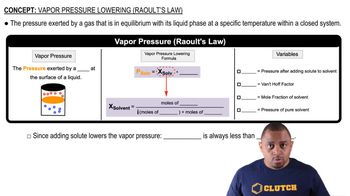
Raoult's Law
Raoult's Law states that the vapor pressure of a solvent in a solution is directly proportional to the mole fraction of the solvent in the solution. For a mixture of volatile components, the total vapor pressure is the sum of the partial pressures of each component, which can be calculated using their respective mole fractions and pure component vapor pressures.
Video consigliato:
Percorso guidato
Raoult's Law and Vapor Pressure
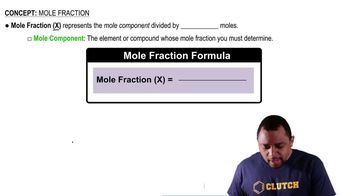
Mole Fraction
Mole fraction is a way of expressing the concentration of a component in a mixture. It is defined as the ratio of the number of moles of a specific component to the total number of moles of all components in the mixture. This concept is crucial for applying Raoult's Law to determine the contributions of each component to the overall vapor pressure.
Video consigliato:
Percorso guidato
Mole Fraction Formula
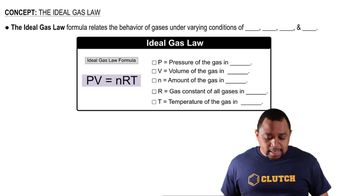
Ideal Gas Behavior
Ideal gas behavior refers to the assumption that gases behave according to the ideal gas law, where interactions between gas molecules are negligible, and the volume of the gas molecules themselves is also negligible. In the context of solutions, assuming ideal behavior allows for the simplification of calculations involving vapor pressures and mole fractions, making it easier to predict the properties of the mixture.
Video consigliato:
Percorso guidato
Ideal Gas Law Formula
Pratica correlata
Domanda del libro di testo
1207
views
Domanda del libro di testo
A glucose solution contains 55.8 g of glucose (C6H12O6) in 455 g of water. Determine the freezing point and boiling point of the solution.
3181
views
Domanda del libro di testo
Calculate the vapor pressure of a solution containing 24.5 g of glycerin (C3H8O3) in 135 mL of water at 30.0 °C. The vapor pressure of pure water at this temperature is 31.8 torr. Assume that glycerin is not volatile and dissolves molecularly (i.e., it is not ionic), and use a density of 1.00 g/mL for the water.
3150
views
